Tuesday, January 1, 2019

Tesla CEO Elon Musk’s year in one chart

Three point eight.

From the first day of trading in 2018 to the last, that was the final percentage difference in Tesla’s share price. Taken on its own, the number is a modest and positive gain — and far more fruitful than automakers Ford, GM and Fiat Chrysler. It’s a number that suggests a consistent year of upwards momentum for Tesla, steady and diligent like a tugboat, even keeled and untouched from stormy market seas.

Those two bookends of the stock market calendar — January 2 and December 31 — and the 3.8% gain they produced obfuscates what really happened to Tesla and CEO Elon Musk in 2018.

It wasn’t quiet. It wasn’t calm. It wasn’t constant or consistent. Tesla wasn’t a tugboat in 2018; it was a whipsaw.

The year was a dizzying ride that took Tesla shareholders and fans, critics, car owners, and employees, the media and Musk himself to extreme highs and troubling lows — sometimes flip-flopping twice or more in a few days time.

And it was exhausting because so much of it seemed self-inflicted and avoidable.
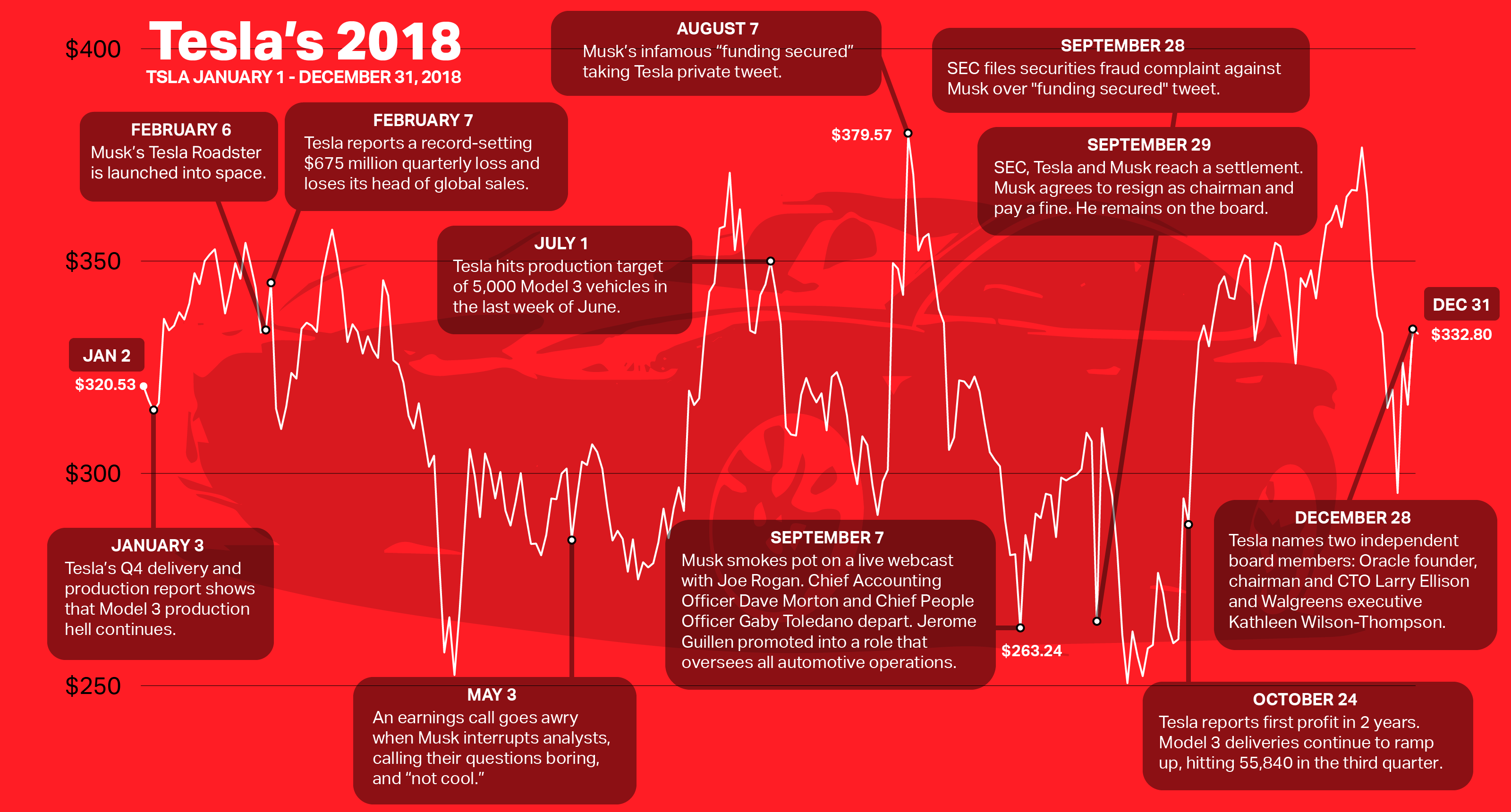
 

The chart illustrates the ups and downs of Tesla’s share price along with specific highlights. But there were so many more.

As Tesla floundered early in the year, hamstrung by production hell of its Model 3, Musk’s company SpaceX made history when it completed a test of its Falcon Heavy rocket, the heavy-lift orbital vehicle that can carry twice the weight of its closest competition in active operation. 

As production hell dragged on through the first quarter and into the second, Musk locked in a performance-based package that granted him $2.6 billion in stock options over 10 years. Moody’s would downgrade Tesla’s credit rating to negative from stable and Musk would make an untimely April Fool’s Day joke that the company was “bankwupt.”   

It turns out those jokes weren’t so far off.

Tesla was burning through millions of dollars a day as the company tried to solve production bottlenecks in its factory.

“Tesla really faced a severe threat of death due to the Model 3 production ramp,” Musk said in an interview with Axios in November. The company was within “single-digit weeks” of dying, he added.

Other problems emerged as Musk and his employees scrambled to solve that very real and impending existential threat to Tesla. There was the unfortunate unhinged analyst call and a spat with the National Transportation Safety Board over a fatal crash and investigation into the automaker’s semi-autonomous Autopilot system.

And then it happened. Tesla, which appeared to be in a death spiral, produced 5,000 vehicles in a week. It was a triumph. The naysayers were proven wrong; the critics were silenced; the shorts would convert!

And it was only July 1.

The rest of the year played out much the same way the first half did, just with a few new characters and twists from the “pedo guy” episode that played out on Twitter and Musk’s “funding secured” tweet to pot-smoking, SEC investigations, and earning its first profit in two years.

The last quarter of the year was marked by advancements in its Autopilot system, lawsuits and subpoenas, a new Tesla chairman, two new board members Larry Ellison and Kathleen Wilson-Thompson, and further expansion into China.

Tesla’s rollercoaster ride of a year was stomach churning — or thrilling, depending on your point of view — without Musk engaging in Twitter. But his frequent use of the social media tool repeatedly pulled the company, or himself, back into an abyss of petty fights, distractions and at its worst, potential derailments to a company he has invested so much of his time, money and emotion in.

In 2019, with the Model 3 moving into new regions of the world and hints of other grander plans, Tesla deserves, and will need, a captain with both hands on the wheel. Elon, take the wheel.


from TechCrunch https://tcrn.ch/2LNSZju

Amazon India teases Huawei Y9 2019 availability

Amazon India has set up a teaser page for the launch of the Huawei Y90 2019 smartphone. The teaser doesn't mention the date of the launch and prefers to keep it vague with a "Coming Soon!". However, you can register to get an email from Amazon when the phone is available for purchase. The Huawei Y9 2019 is a budget smartphone from Huawei. It has a 6.5-inch IPS display with a resolution of 2340x1080. It doesn't have any of the fancy teardrop notches and instead a more traditional looking one but it justifies it to some extent by having a dual front camera. The Y9 2019 is powered by...


from GSMArena.com - Latest articles http://bit.ly/2EYFmwq

Top 10 most popular reviews of 2018: Q4

Closing off our most popular reviews series it's time to take a look at the final three months of the year. Coming in as the most read review in Q4 is non other than the OnePlus 6T. OnePlus' latest flagship got a lot of things right, like the great screen with a reduced notch, the in-display fingerprint scanner, the improved camera and most importantly with the better battery life. In second is the Huawei Mate 20 Pro. If there was a phone this year that tried to upset the Galaxy Note9 as the most feature-packed phone of the year, it was the Mate 20 Pro. From the AMOLED display, the...


from GSMArena.com - Latest articles http://bit.ly/2s1jBEi

The end of China’s ride-sharing gig

Over the last few years, millions of Chinese workers managed to earn extra money by being ride-hailing drivers. Many picked the gig because of its flexible schedule. For those who could not otherwise afford to own a car in China’s pricy metropolises, driving around is also a status symbol, even if they are paying off car loans every month.

Most drivers on Didi Chuxing — the startup that captured 90 percent of China’s e-hailing trips in 2017 per consulting firm Bain & Company — were part-time. That’s according to a report Didi put out in October 2017, which said half of its drivers worked less than two hours a day.

The report also hailed Didi as the epitome of China’s “sharing economy,” something that Beijing has been keen to promote to spur economic growth. The all-encompassing term, which includes shared platforms from mobility to elderly care services, raked in $764 billion in 2017, shows a report by China’s Sharing Economy Research Center of the State Information Center.

But gig work in China’s fledgling ride-hailing industry is coming to an end as new regulations make part-time driving overly expensive.

No more gigs

On January 1, ride-hailing apps in China start banning drivers who operate without the required “double licenses”: one for drivers and another for the cars they steer. Municipal governments across the country have nuanced stipulations for what these certificates entail, but in general, the fresh rules aim to more closely vet drivers transporting passengers around.

To obtain the ride-hailing driver’s permit in certain cities, drivers must own a local hukou, the residency permit that controls where people can legally work. A lot of ride-hailing drivers don’t have an urban hukou as they are migrant workers from rural parts of China, so they immediately become ineligible for ride-hailing apps.

The car license, on the other hand, requires the vehicle to operate as a commercial one, bringing additional costs to drivers who must absorb the costs of car insurance and maintenance, and scrap their vehicle after 8 years.

didi chuxing

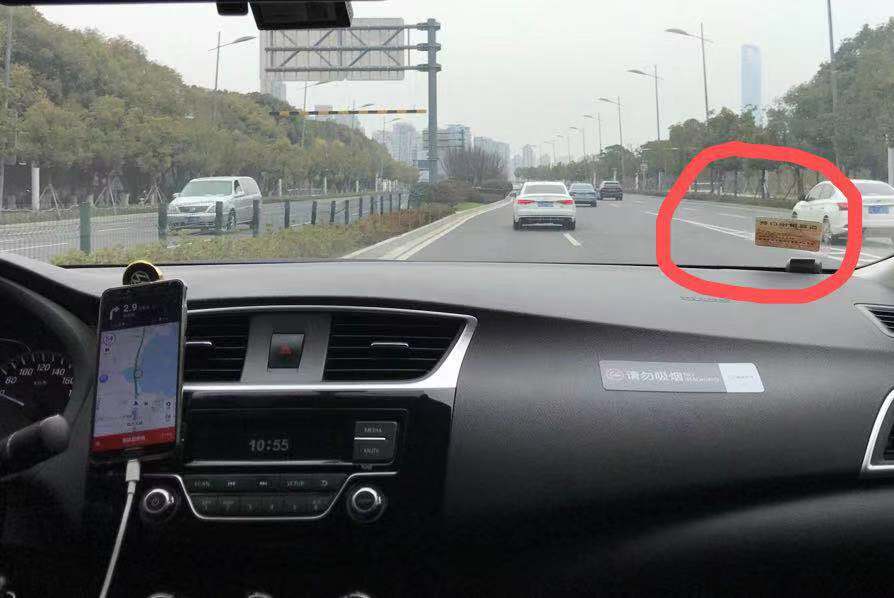
All ride-hailing vehicles in China must possess the required license (circled in red) to be on the roads starting January 1, 2019. Photo credit: TechCrunch

Under the new legal framework, drivers can still work as independent contractors. But in effect, the policy shift is driving out casual workers. “No part-time drivers want to register their private car as a commercial one because of the high costs that come with it,” a Shenzhen-based Didi driver tells TechCrunch. “Being part-time doesn’t pay the bills anymore.”

Didi’s dilemma

Like a lot of China’s nascent industries, ride-hailing took off quickly in part thanks to relatively lax government oversight at the start. The first set of industry laws took effect in 2016 when the country officially legalized apps like Uber, which was later acquired by its local competitor Didi. Since then Chinese authorities have gradually rolled out more rules and the strictest regulations, including the rollout of the double licenses, came following the deaths of two passengers who used Didi last year.

The new policies have put a squeeze on driver and car numbers. In the Tier 2 city of Nanjing alone, Didi claims to have weeded out more than 160,000 illegal vehicles, local media reported. The sharp decline in cars available on the roads inevitably leads to longer wait time and user frustration, and the $56 billion giant will need to think of ways to maintain a constant supply of drivers.

Didi took off on account of generous subsidies for both users and drivers, but its staggering loss — which is said to stand at $585 million in the first half of 2018 — means it may not be offering cash-heavy incentives in the near term. To retain labor, Didi is offering test prep for drivers. It’s also lowered the barriers to entry by letting drivers rent licensed cars it sources from car rental and automaker partners. A catchphrase started to pop up on Didi’s mobile app for drivers in December: “You supply the manpower, we provide the car.”

Aside from regulatory hurdles, Didi also faces new challengers like BMW and Volkswagen’s China partner SAIC Motor, traditional carmakers that are entering the ride-hailing scene.

“Didi has educated China about what is ride-hailing. If it doesn’t react swiftly to changing dynamics, the billions of yuan it’s burned through will suffer from low returns,” Dong Feng, founder of a Chinese car rental startup suggests to TechCrunch.


from TechCrunch https://tcrn.ch/2F1KuQv

Top news of 2018: Q4

Premium prices should come with premium quality. There are always issues with large scales mass production though and the Huawei Mate 20 Pro was the latest to experience it - its screen had a green glow seen in the dark. That wasn't the company's biggest headache this year, however, as the USA pushed its allies to drop its products. When the Xiaomi Redmi Note 6 Pro arrived at the office readers were eager to see it unboxed and reviewed. The launch of the Mi Mix 3 was Xiaomi's other win in Q4 in terms of most-read articles. However, Samsung dominated the field, creating a ton of buzz...


from GSMArena.com - Latest articles http://bit.ly/2Rppjy9

Xiaomi drops prices for its televisions in India

Xiaomi has announced that it is slashing prices on select television models in India. The Mi LED Smart TV 4A 32 will now be available for INR 12,499 ($179), down from the previous INR 13,999 ($201). The Mi LED TV 4C PRO 32 will now be available for INR 13,999 ($201), down from the previous INR 15,999 ($229). The drop in prices is due to the change in government levied taxes on televisions up to 32-inches in size from 28% to 18%, and Xiaomi is passing on the savings to the customer. Xiaomi also dropped the price of the Mi LED TV 4A PRO 49 from INR 32,999 ($473) to INR...


from GSMArena.com - Latest articles http://bit.ly/2F1sw13

The Top 20 most popular phones of 2018

We are sending away 2018 and we look back and see what were the most popular phones over the past year. While there are 20 phones in the yearly selection, the list of manufacturers is scarce. To be more precise, two out of every three devices come from either Xiaomi or Samsung. Samsung brought us 7 of the most popular phones in 2018 - hardly a surprise that the world's largest manufacturer dominates the popularity chart. Somewhat less expected is that Xiaomi got 6. Last year, the number for the Korean manufacturer was the same, but the Chinese maker is up by one, showcasing...


from GSMArena.com - Latest articles http://bit.ly/2SvbqvQ