Tuesday, November 30, 2021

UK’s antitrust watchdog orders Facebook to sell Giphy

In a significant push against big tech’s ability to maintain market dominance through sheer buying power, the UK’s competition watchdog has ordered Facebook (now Meta) to reverse its acquisition of animated GIF platform, Giphy — confirming the Financial Times‘ earlier reporting.

The Competition and Markets Authority (CMA) said its phase 2 investigation cemented earlier competition concerns about the impact of Meta owning and operating Giphy.

In a statement, Stuart McIntosh, chair of the independent inquiry group heading the CMA probe, said: “The tie-up between Facebook and Giphy has already removed a potential challenger in the display advertising market. Without action, it will also allow Facebook to increase its significant market power in social media even further, through controlling competitors’ access to Giphy GIFs.”

“By requiring Facebook to sell Giphy, we are protecting millions of social media users and promoting competition and innovation in digital advertising,” he added.

This story is developing… refresh for updates… 

The watchdog’s intervention follows an extended investigation of the acquisition that Facebook announced (and completed) in May 2020, with the CMA taking an initial look in summer 2020 — and dialling up its scrutiny over the following months.

It also, in June 2020, ordered a halt to further integration of Giphy by Facebook while the oversight continued.

In another first last month, the regulator fined Facebook almost $70 million for deliberately withholding information related to ongoing oversight of the acquisition — billing the infringement a “major” breach.

The CMA’s preliminary report on the acquisition, this August, concluded that Facebook’s takeover of Giphy raised a number of competition concerns — including that it would harm competition between social media platforms, given the lack of choice in the supply of animated GIFs.

The regulator’s concern was not only that Facebook might simply deny rivals access to Giphy content for their users to reshare but that the data-mining giant might change the terms of access — and could, for example, require rivals like TikTok, Twitter and Snapchat to provide it with more user data in order to access Giphy GIFs.

The CMA appears to have held to its concern on the risk of competitive harm through data extraction from other services, as well as from other more obvious risks — such as Facebook shutting off rivals’ access to the platform — hence rejecting all the tech giant’s proposed alternative ‘remedies’ to selling the unit as insufficient.

“After consulting with interested businesses and organisations — and assessing alternative solutions (known as ‘remedies’) put forward by Facebook — the CMA has concluded that its competition concerns can only be addressed by Facebook selling Giphy in its entirety to an approved buyer,” the CMA writes in a press release.

In the summer the watchdog had also said it was concerned about the impact on digital ‘display’ advertising — as Giphy had, pre-merger, been offering paid advertising services in the US (and considering expanding to other countries including the UK) with the potential to compete with Facebook’s ad services. An ambition that terminated with Facebook’s takeover.

“The CMA found that Giphy’s advertising services had the potential to compete with Facebook’s own display advertising services. They would have also encouraged greater innovation from others in the market, including social media sites and advertisers. Facebook terminated Giphy’s advertising services at the time of the merger, removing an important source of potential competition. The CMA considers this particularly concerning given that Facebook controls nearly half of the £7 billion display advertising market in the UK,” the regulator writes now.

A summary of the CMA’s final report can be found here.

Meta/Facebook has been contacted for its response to the CMA’s order to undo the Giphy acquisition.

The company responded aggressively to the CMA’s provisional findings this summer — denouncing the analysis and questioning the UK regulator’s jurisdiction over its business.

However concern over so-called ‘killer acquisitions’ — aka the ability of tech giants’ to flex their financial muscle to protect market power by buying budding competition to defuse the risk posed by startups and new services (sometimes literally by closing them down post-purchase) — has been a major topic of concern among industry watchers for years.

The critique centers on how competition regulators have failed to evolve theories of harm to keep pace with digital market dynamics. Failing, for example, to consider how data itself can be used as a tool against competition. Dominant platforms can also easily leverage their market power in one channel to rapidly scale into a new segment, via tactics like self-preferencing. While ‘free’ at the point of use services may still entail significant harms for consumers — such as abuse of their privacy.

In recent years, legislators and regulators have started to respond to such concerns — including by updating rules, such as in Germany which passed an update to its regime to cover digital platforms at the start of this year. (The country now has a number of open procedures against tech giants (including Facebook) to confirm its ability to impose preemptive measures.)

In the US, the Biden administration’s elevation of Lina Khan to chair the FTC, earlier this year, marks key moment of change on US soil — signalling lawmakers’ support for a reformist approach toward regulating tech.

It follows Khan’s landmark paper (on Amazon) which examined how the government’s outdated ways of identifying monopolies have failed to keep up with modern business realities. What was initially dismissed by some — as ‘hipster antitrust’ — is now setting the establishment regulatory agenda. Although Khan still faces huge opposition on home soil from the tech lobby working through channels like the US Chamber of Commerce.

Over in the EU, the Europe Commission has also been working to address the lag between tech and antitrust.

Since December it’s had a draft proposal on the table for a set of ex ante rules to apply to intermediating platform giants (aka, those classified as ‘gatekeepers’ under the Digital Markets Act). Although whether the DMA goes far enough to actually help reboot competition remains to be seen.

The UK, now outside the bloc, has its own update to domestic competition law incoming, also aimed at tackling platform power — with a new regime of bespoke rules for platforms deemed to have ‘strategic market status’.

All this comes too late to undo plenty of baked in tech consolidation, however. But not too late to undo Facebook-Giphy.

Outdated approaches to regulation of digital markets has allowed thousands of tech acquisitions to be waived through over the past decades — including Facebook’s purchase of photo-sharing site Instagram, messaging platform WhatsApp and VR headset maker Oculus, to name three strategic takeovers which span the core social networking arena that Facebook/Meta owns and wants to keep owning for decades to come (in an even more immersive/invasive form; aka “the metaverse”).

Earlier this year, the Commission failed to block Google’s acquisition of health wearable Fitbit — despite a huge outcry from civil society warning out letting the adtech giant gobble up such sensitive data, for example.

More recently the CMA also cleared Facebook’s acquisition of CRM maker Kustomer — again using a fairly narrow assessment of potential competition risks — and entirely ignoring privacy advocates who were raising concerns over what the adtech giant would do with Kustomer users’ data.

The CMA’s decision now to order Facebook to reverse its acquisition of Giphy is a significant development — albeit, it’s still just one decision that hasn’t gone big tech’s way.

Discussing the move in response to questions from TechCrunch, professor Tommaso Valletti, a former chief competition economist within the Commission — who worked under current EVP Margrethe Vestage — described the CMA’s move as a “highly symbolic decision”. But he cautioned against reading too much into one ‘no’.

“I’ve been repeating the figures “1000 and 0”: mergers done by GAFAM and mergers blocked in past 20 years. So having finally a 1 does not change the overall picture but it’s a signal,” he told us.

Earlier this year the Commission made it possible for Member States to refer cases for merger review when they may fall between the cracks of national antitrust policy, with the risk of an innovative tech or business being acquired (on the cheap) by a more established rival in order to kill budding competition.

Valletti also pointed out that Vestager has finally signalled an intention to discuss big tech acquisitions with US lawmakers — which he dubbed “another good sign”, saying the EU “was (and still is) lagging on this”.

Major reworking of how antitrust gets applied in the US will clearly be essential to rein in what remain (mostly) US tech giants — however innovative the actions of individual regulators (such as the CMA) elsewhere.

“As for ‘new’ theories of harm, I think it’s just that the CMA has good economists that are aware of what economics has being saying and finding in the past 10 years: Data are part of the business model, so they must be part of the competitive assessment too,” Valletti added of its decision on Facebook-Giphy. “It’s not ‘just’ a privacy issues dealt by someone else.

“Good economics, openness of mind, and a higher risk appetite by their leadership, means the CMA is trying to move the bar in a typically extremely conservative field with shy regulators. Let’s be hopeful!”

As noted above, the UK is working on a reform of competition law that’s specifically targeted at platform giants — with so called ‘strategic market status’ — who will be regulated under an ex ante require of bespoke rules in the future. Although the necessarily legislation to empower the dedicated Digital Markets Unit that’s been set up to focus on this area is still pending.

Still, the CMA hasn’t been sitting on its hands in the meanwhile, with a number of open investigations into various aspects of big tech’s business and ongoing scrutiny of acquisitions.

The UK’s regulatory regime has a free hand to go its own way on big tech decisions — given the country is not longer a member of the EU. Although UK regulators have said the continue to consult with international counterparts on issues of common concern.

While the bloc is seeking to harmonize digital regulations under the DMA and Digital Services Act, there has been some concern that EU lawmakers’ push to reduce ‘fragmentation’ may end up benefiting tech giants — i.e. if it removes the ability of individual Member States to pass more ambitious legislation.

UK regulators could, therefore, end up addressing shortfalls in the bloc’s one-size-fits-all plan for a list of ‘dos and don’ts’ for platform giants — by applying a more tightly tailored regime to tech giants. Having creative thinking at the CMA therefore looks vital.


from TechCrunch https://ift.tt/3o2N7Yi

LG Energy Solution gets Korea Exchange’s nod for planned IPO

LG Energy Solution, the battery unit wholly owned by LG Chem, received preliminary approval for an initial public offering, the Korea Exchange said in a statement on Tuesday.

LG Energy Solution is reportedly planning to submit its IPO application to Financial Supervisory Service as early as this week, aiming to list at the end of January.

In June, LG Energy suspended its IPO process on the heels of a series of recalls from American automaker General Motors’ Chevrolet Bolt electric vehicles due to possible battery cell defects that could increase the risk of fire. 

General Motors has said it would seek reimbursement from LG Chem, GM’s battery cell manufacturing partner, for its estimated $1 billion worth of losses. LG Energy and LG Electronics settled the recall issue by setting $ 1.1 billion (1.4 trillion won) as expenses to pay GM for the Bolt EV recalls.

LG Energy Solution said last month it will resume its planned IPO after reaching an agreement over the recall-related issue with General Motors in September. 

Seoul-based analysts have forecast an IPO size of $8.3billion (10 trillion won) after estimating LG Energy Solution’s valuation at between $50.5 billion (60 trillion won) and $58.9 billion, which would be one of the largest IPO deals in South Korea.

The company spokesperson declined to comment on its IPO detail. 

LG Energy posted $11.2 billion in revenue as of September, based on its financial report.

LG Energy Solution competes with China’s CATL and BYD, Japan-based Panasonic and South Korea’s SK Innovation and Samsung SDI. 

LG Chem has unveiled a plan to invest $5.2 billion through 2025 to ramp up its battery business in the U.S.

LG Chem said last week LG Energy Solution Michigan plans to raise $1.36 billion in funding to establish new EV batteries production facilities in North America. The company will use the proceeds to increase EV batteries and energy storage systems (ESS) production, meeting growing demand.

In October, LG Energy and Stellantis announced a preliminary deal, which still must be approved by the regulators to form a joint venture to produce battery cells and modules in North America, with an annual capacity of 40 gigawatt-hours.

The company also has made a six-year agreement with an Australia-based mining firm for the stable supply of key minerals (cobalt and nickel) used in cathode production. 


from TechCrunch https://ift.tt/3E7Ii5J

MIUI 13 to come pre-installed on new Redmi K50 series

Xiaomi is expected to launch the MIUI 13 later this year, likely alongside the Xiaomi 12 flagship line. The latest reports are the user interface will also come pre-installed in all Redmi K50 smartphones. Digital Chat Station claimed on Weibo that the Redmi K50 phones with Dimensity 7000 and Dimensity 9000 will be underperforming compared to their siblings powered by new Qualcomm Snapdragon 8 Gen1 chips. The Redmi K40 lineup consists of four devices and has three different chipsets. We expect even more diversity with the new lineup - the Redmi K50 (or Redmi K50 SE) will be powered...


from GSMArena.com - Latest articles https://ift.tt/3FZ1WkH

Soveren launches from stealth with $6.5M seed funding to automate GDPR compliance

Soveren, a London-based startup that automates the detection of privacy risks to help organizations comply with GDPR and CCPA, has launched out of stealth with $6.5 million in seed funding.

The company analyzes real-time data flows inside an organizations’ infrastructure to discover personal data and detect privacy risks to make it easier for CTOs and CISOs to recognize and address privacy gaps. Soveren says some 10 million companies globally are at risk of violating GDPR and other regulatory obligations because of their failure to detect and resolve privacy incident.

“Security software successfully addresses security threats, but has a limited impact on addressing privacy challenges,” Peter Fedchenkov, founder and co-CEO of Soveren, tells TechCrunch. “This is because, unlike other confidential data that can be easily isolated, personal data is actually meant to be accessed, used, and shared in day-to-day business operations. We believe that privacy is the new security because it demands the same automated, continuous protection measures.”

Fedchenkov says the idea for Soveren came from his personal experience in the e-commerce sector. “We saw first hand how manual and complex data protection and privacy compliance is today. It takes more time, more money, and more effort than it really should.”

So far, Sovern has so far secured 10 lighthouse customers across software, e-commerce, travel, fintech, and healthcare in North America and Europe.

The firm is now planning to expand globally after securing a $6.5 million seed investment, which was led by Firstminute Capital with participation from Northzone, 11 unicorn founders including Airbnb and Mulesoft, Sir Richard Branson’s family, and a handful of global CEOs including Nikesh Arora, the chairman CEO of Palo Alto Networks.

Fedchenkov says, to begin with, Soveren will use the funds to expand its product team and to invest in sales and marketing. “We haven’t actually done anything on the marketing side yet, so we definitely want to double-down on that,” he tells TechCrunch.


from TechCrunch https://ift.tt/31dtl3F

Partech raises $750 million growth fund

Paris-based VC firm Partech has announced the closing of the fundraising of its new growth fund. Partech Growth II is the firm’s second growth fund. And the team managed to raise $750 million.

As a reminder, Partech Growth I was a smaller fund with €400 million under management, which represents $460 million at today’s exchange rate. Partech closed Partech Growth I back in 2015.

When it comes to today’s fund, backing comes from 45 institutional investors, such as endowments, foundations, pension funds, life insurers, asset managers and fund-of-funds. Around 40 family offices, entrepreneurs and business angels also participated directly in the new fund.

Partech has already started deploying some of the fund in tech companies. Portfolio companies include Rohlik, a grocery delivery company from Czech Republic (more details in Ingrid Lunden’s article), Skello, a work scheduling software-as-a-service tool (more details in my separate article), Studocu, a note sharing platform for college students (Ingrid also covered it here) and recurring payment platform Billogram (more from Ingrid).

“We’re humbled and grateful for the support of, and commitment from, our global investors. It allows us to continue to deliver meaningful and strategic assistance to the outstanding community of European tech entrepreneurs who decide to welcome us on their journey,” Partech Growth General Partner Omri Benayoun said in a statement.

Partech plans to invest across many different verticals, both enterprise and consumer companies, across multiple industries. The firm plans to invest in 12 to 15 companies with an average check ranging from $22.4 million to $78.4 million (€20 million to €70 million).


from TechCrunch https://ift.tt/3pfH6qs

Jump brings stability to freelancers by giving French permanent contracts

French startup Jump wants to disrupt the industry of umbrella companies. Those companies provide an alternative to traditional freelancing jobs. They can hire workers on permanent contracts so that they get the stability and the benefits that come with a full-time contract. But workers remain independent — they can work with multiple clients and they negotiate their contracts directly.

What makes Jump different from legacy companies operating in the space is that it’s much cheaper and much more automated than what’s already available. Jump lets you create an account and send your first invoice automatically — you don’t have to talk to anyone at Jump to get started.

Once you sign up, you can start asking your clients to pay Jump instead of paying you directly. At any time, you can see your outstanding invoices and how much money you have on your Jump account.

Jump customers can then create payslips and receive a salary. And because it’s a regular French permanent contract, you are registered with the national healthcare system and you start saving for your retirement. If things are not going well with your client, you can request a rupture conventionnelle and become eligible for unemployment benefits.

The company raised a $4.5 million (€4 million) seed round led by Index Ventures. Kima Ventures and 16 angel investors also participated in the round, such has Nicolas Brusson, Hanno Renner, Laurent Ritter and Thibaud Elziere.

Traditional umbrella companies take a cut of your annual turnover. Pricing varies but it can be 5%, 7% or even sometimes 10%. For instance, Jump’s co-founder and CEO Nicolas Fayon used to work for ITG, which charges 6% to 8% on your revenue. You can also pay ITG an additional 2% to manage expenses and therefore optimize your pay.

Jump currently charges a flat subscription fee of €79 per month (that’s $89). Customers can then access third-party services, such as professional and personal life insurance with Axa, health insurance with Alan, several freelance marketplaces (Malt, Talent.io and LeGratin) and other miscellaneous services (Simbel, Secret or HelloPrĂȘt).

So far, Jump has been working with hundreds of freelancers. They have invoiced €3 million to date. Many freelancers could benefit from such a product, such as developers, real estate agents or drivers. And I believe there’s a big market opportunity for umbrella companies as they could be particularly useful for people working remotely for foreign companies that don’t want to open a subsidiary in France.


from TechCrunch https://ift.tt/3xBAzu0

Developer productivity tools startup Raycast raises $15M from Accel and Coatue

Developer-focused productivity tool Raycast has raised $15 million in Series A funding, led by Accel and Coatue. Also participating in the round were angel investors Johnny Boufarhat, the CEO and founder of Hopin; Jeff Weinstein, the head of product at Stripe; Jason Warner, the former CTO of GitHub and Ott Kaukver, the CTO of Checkout.com, among others.

Raycast was founded in 2020 by former Facebook software engineers, Thomas Paul Mann and Petr Nikolaev, who sought out to create a way to recover the time developers lose every day due to continuous context-switching between different SaaS tools.

“We started the company because we wanted to improve how we work with computers,” Raycast CEO Thomas Paul Mann told TechCrunch in an interview. “As developers ourselves, we find ourselves spending a lot of time on busywork that doesn’t bring that much value. We’d rather spend our time on the work that actually matters. This is the premise of Raycast, we bring you a tool that helps you get work done faster.”

Raycast aims to make it easier for developers to find and update information with its command-line-inspired interface. The platform enables the automation of day-to-day processes and tasks and allows developers to focus on important tasks. The desktop software takes a note from peers like Superhuman and Command E, allowing users to quickly pull up and modify data with keyboard shortcuts. Users can easily create and re-modify issues in Jira, merge pull requests in GitHub and find documents. The software is essentially a developer-focused version of Apple’s Spotlight search, which aims to help software engineers navigate all the parts of their job that aren’t development work using a single tool.

In terms of growth, Raycast says that in just 12 months, it has increased its daily active user base from 130 in October 2020 to over 11,000 to date, with more than 20 million actions performed on the platform in that time. The team currently consists of 12 members, with more people expected to join by the end of the year as the company looks to hire more employees.

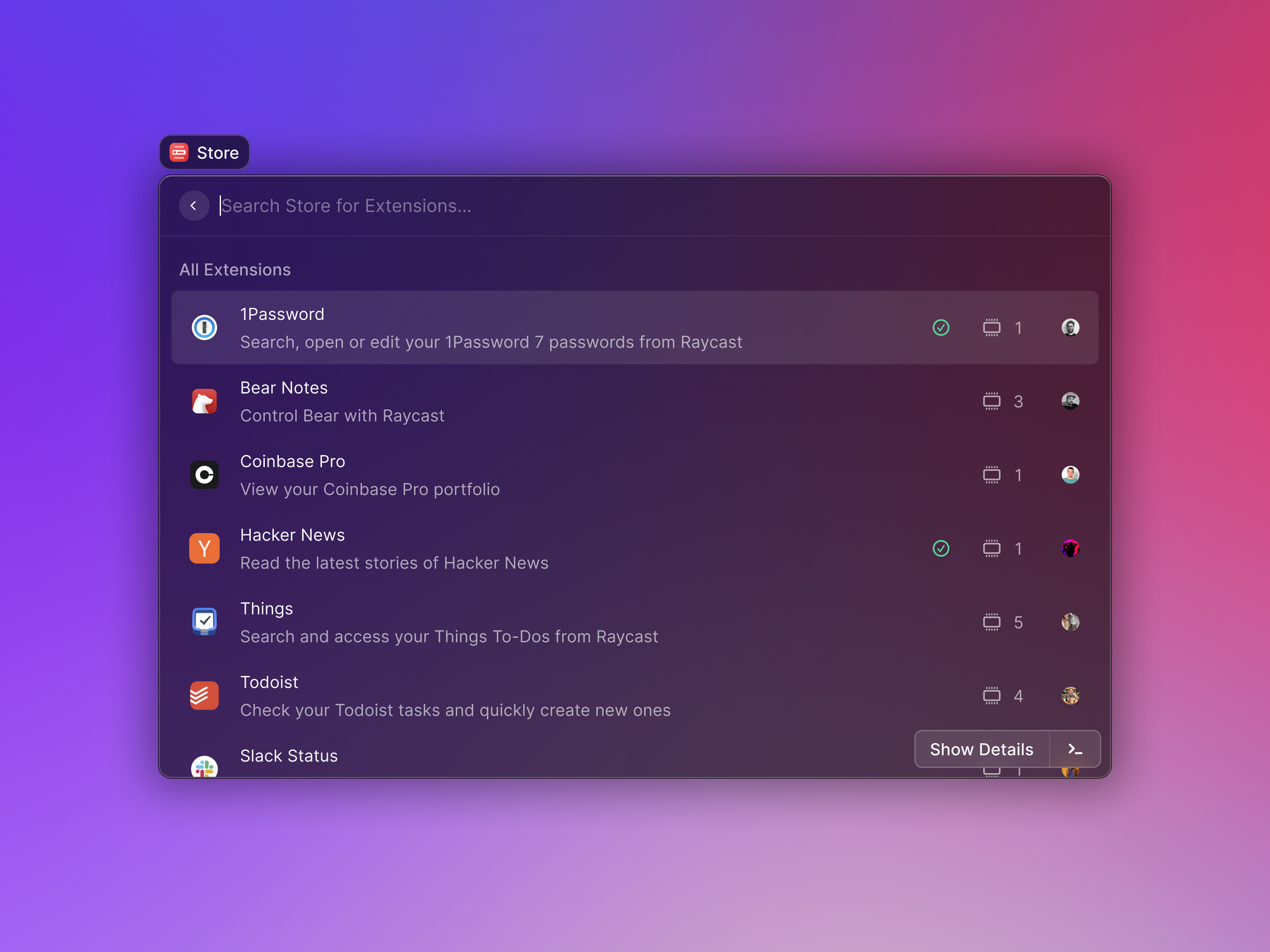
Raycast has also released its Extensions API and Store in public beta, giving developers the ability to build custom extensions and share them with their team or community. The company says that in one month, the community built more than 100 extensions on the beta, connecting to services like Figma, GitHub, Chrome, Notion, YouTube, Twitter and more. Raycast is now publicly launching the Extensions API and Store, opening it up to developers around the world.

Image Credits: Raycast

As for the new funding, Mann says Raycast wants to become the leader in developer productivity. “That’s our goal with the funding. We will use the funding to scale our team further up. We want to make this platform universally accessible to everyone so that they can build the tools they want to have,” he said.

Raycast plans to use the funding to focus on building its community of developers and tools, accelerate growth on the platform and also bring Raycast to teams. Although the company will remain heavily focused on individual developers, Raycast sees potential in making it easy to share productivity tools and workflows with others. Starting today, companies will be able to sign up for an early access program to get access to new team features. Users will be able to create their own internal store, where they can build and distribute custom extensions and links specific to the needs of their teams.

“Teams can now build extensions and share them privately with their team members,” Mann stated. “If they have an internal tool that makes themselves more productive with the custom setup they have, they can share that with their team members so they can benefit from it as well. This helps them stay productive as a team and saves them time on the busywork they usually have.”

Raycast’s Series A funding follows the company’s $2.7 million seed round from October 2020. The round was led by Accel, with participation from YC, Jeff Morris Jr.’s Chapter One fund, as well as angel investors Charlie Cheever, Calvin French-Owen and Manik Gupta.

“Since leading Raycast’s seed investment, we’ve been impressed with the growth and traction Raycast has seen in the developer community.” said Andrei Brasoveanu, a partner at Accel, in a statement. “This backs up our initial belief that Raycast has the potential to become an indispensable tool for developers, and we’re excited to see the team go even further with the launch of the API and Store and expansion to teams. We’re delighted to continue supporting Thomas and Petr on their ambitious journey.”


from TechCrunch https://ift.tt/3d0AIOj