Tuesday, March 1, 2022

Australia’s CryptoTaxCalculator helps traders demystify the decentralized

Just in time for tax season in the United States, Australian startup CryptoTaxCalculator (CTC) announced it has raised seed capital to expand its automated crypto tax reporting tool further into the U.S. market. Sydney-based CTC is one of many platforms that have gained popularity this year for helping crypto traders navigate the complexities of filing their taxes, though it differs from most of its counterparts in that it is mainly focused on solving problems faced by users of decentralized exchanges.

If you’re paying taxes on crypto you bought or sold through a centralized crypto exchange like Coinbase, Binance, or Gemini, understanding what you owe might be simple, since you can download a form from many of these exchanges detailing your trades, gains, and losses. But for those transacting on decentralized exchanges such as Uniswap or Curve, the process can be far more onerous — and that’s where CTC is most helpful, co-founder and CEO Shane Brunette told TechCrunch in an interview. 

CTC has grown from 3 full-time employees last fall to nearly 30 today. Its platform serves over 80,000 users today, up 1,700% in the past year, according to the company. Brunette attributes this growth, in part, to the surging popularity of decentralized finance (DeFi), which CTC is built to support because of its expertise in decentralized transactions.

Unlike with transactions conducted on a centralized exchange, decentralized, on-chain transactions are not recorded by a trusted third-party middleman who can provide a user with their transaction history for tax filing purposes, Brunette said.

 Brunette, an avid crypto trader himself, saw these challenges firsthand when he had to file taxes on his trades. He co-founded CTC along with his brother, and they decided to launch the product on Reddit in 2018, he said. CTC was initially focused on integrating with decentralized apps built on Ethereum Virtual Machine (EVM), according to Brunette, but it has since grown to integrate with more than 400+ exchanges, its website shows.

The company supports users in 21 different tax jurisdictions, and roughly 40% of those users are in the U.S. while another 40% are in Australia, Brunette said. He noted that a large portion of CTC’s U.S.-based users has joined the platform more recently, particularly since mid-2020’s “DeFi summer.

“You can actually think of something like the Ethereum network as being one giant accounting ledger, which has all transactions since the beginning of time, of all parties and what they’ve been doing on that particular chain. The thing is that it’s been written in a way that’s quite convoluted when it comes to an accounting perspective,” Brunette said. 

CTC integrates directly with the blockchains underpinning decentralized exchanges. Users only need to provide their public wallet address to CTC, and the platform aggregates all transactions and smart contracts linked to that wallet, essentially reverse-engineering the wallet’s transaction history, according to Brunette.

While centralized exchanges have become more consolidated as crypto matures as an industry, decentralized finance is exploding, and consolidation in that space cannot occur in the same way, Brunette said.

“The problem that tax authorities are facing, for example, is, how do you go about making sure people are tax compliant when there’s nobody there to go and subpoena, or to give you a transaction history of that individual? How do you keep track of this? And so I think the U.S. government’s take right now is really to try to create legislation that encourages a financial middleman, who can provide that transaction history, but that really clashes with the crypto ethos,” Brunette said.

Brunette has built CTC with an awareness of the skepticism many crypto users have towards centralization and middlemen.
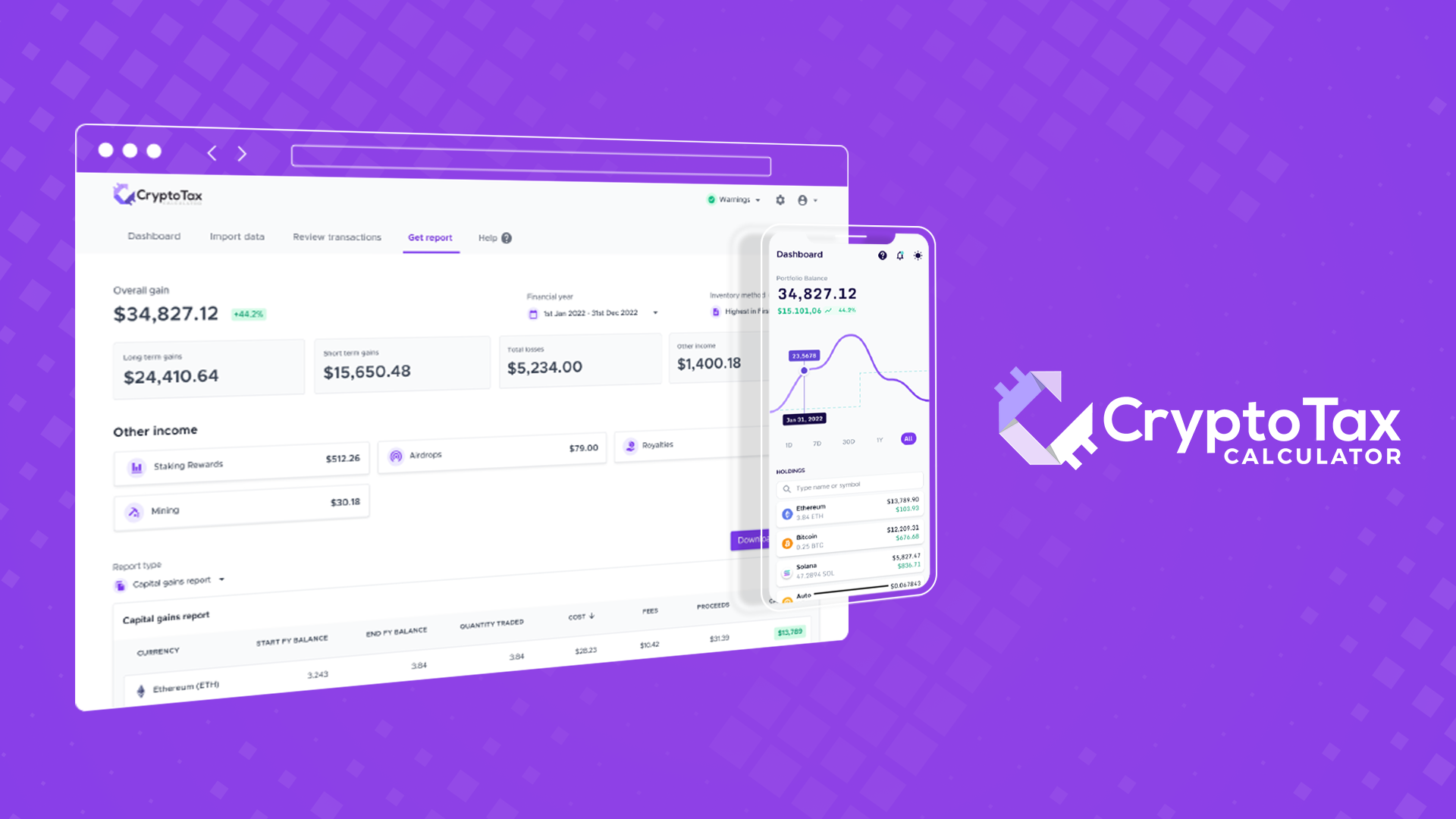
A photo of the CryptoTaxCalculator platform

A photo of the CryptoTaxCalculator platform Image Credits: CryptoTaxCalculator

The blockchain itself “is perfect,” according to Brunette. Anyone can theoretically come and inspect the transaction data stored on a blockchain, but having the right tools to parse through it is necessary, he added.

“That’s what we’re really focused on — building some tools that really facilitate an overview across all the different blockchains as well as being able to pull in a centralized exchange data, so you can get a clear path of an individual’s transaction history, and you can reconsolidate to get to a tax outcome,” Brunette said.

While CTC pulls in all the data needed to build a transaction history and performs tax calculations for its users, Brunette still advises advanced crypto users to consult a tax professional to help them interpret regulatory grey areas to determine what they actually need to pay, and what rules apply to their activity.

CTC doesn’t provide any “final” tax data, but it instead provides aggregate information on what income is taxable, Brunette said.

 “We give you the lump sums, so you can work out what your tax rate is, et cetera, so it’s kind of really categorizing it. So it’s like, you’ve earned this much from staking rewards — now, what do you want to do with it? It’s worth talking to a tax professional and seeking advice,” he said.

The seed round netted the previously-bootstrapped company a total of A$4 million (around $2.9 million in U.S. dollars). Australian venture firm AirTree led the financing alongside U.S.-based Coinbase Ventures and United Kingdom-based 20VC, a fund run by podcaster Harry Stebbings.


from TechCrunch https://ift.tt/65m0hiO

TCL showcases unique foldables at MWC 2022

TCL unveiled a bunch of new phones and tablets over the past days at MWC 2022, but it also had time to show out a few foldable concept phones. We got close to the concepts though we couldn’t use them ourselves. These devices will most likely not make it to consumers anytime soon, but TCL is working hard to bring its first commercially available foldable to the market at an affordable price. TCL 360-degree Ultra Flex The first TCL concept foldable we got to see is the 360-degree Ultra Flex. The big deal here is that the device can be closed with the screen on the inside or on the...


from GSMArena.com - Latest articles https://ift.tt/UAfoYwd

M-KOPA raises $75M as it clocks 2 million customers across four African markets

A 2019 World Bank report says 85% of Africans live on less than $5.50 per day. A large percentage of these adults are unbanked and underbanked; thus, they don’t have access to credit and also can’t afford important purchases outright.

M-KOPA’s financing platform has proved helpful to this set of users since launching as an energy provider in 2011. The company, which enables underbanked customers in select African markets to access a broad range of products and services without collateral or a guarantor, announced today that it has raised $75 million.

The titular “growth equity round” highlighted by M-KOPA in its press statement is its fifth equity round (it has raised similar rounds of debt, too). M-KOPA’s total equity raise stands at $190 million.

Previous backers such as the CDC Group and LGT Lightrock took part in this round alongside LocalGlobe’s Latitude Fund and HEPCO Capital Management. Generation Investment Management and Broadscale Group led the growth equity round. 

The company is led by co-founder and CEO Jesse Moore. M-KOPA is known chiefly for its pay-as-you-go (PAYG) financing model that allows customers to build ownership of appliances over time by paying an initial deposit followed by flexible micro-payments.

M-KOPA started with solar-power home systems targeted at lower-income and rural customers without electricity in Kenya, Tanzania and Uganda. However, it has expanded its pay-as-you-go model to include other needs: smartphones (launched in Kenya two years ago), TVs, refrigerators, solar lighting and digital financial services such as cash loans and health insurance.

The company’s geographical reach has also changed shape. Six years ago, it was heavily focused on East Africa, but having pulled out of Tanzania, M-KOPA is present in Kenya, Uganda, Nigeria and Ghana.

In the company’s more established markets, Kenya and Uganda, customers can access the full suite of M-KOPA’s offerings. But in its other two newer markets, customers are only eligible for smartphone financing at the moment, the founders told TechCrunch. The simple reason is that people need smartphones more than they need solar systems, evident in M-KOPA’s numbers as of July last year — which in 18 months had already sold 500,000 smartphones, half the units solar systems managed in 10 years.

“At the moment when we launch in our new markets, we start with one product which is our smartphone financing. We obviously have a broader portfolio of products in our more mature markets, but to enable a rapid scale-up and to facilitate the early execution in a new market, we start just on the device financing,” M-KOPA COO Mayur Patel said.

Since launching in Nigeria, M-KOPA has acquired over 50,000 customers, its executives said. For Ghana, its newest market, they say it “has grown two times as fast as any of its previous markets.”

As part of its growth plans, which comes off the back of this recent funding, M-KOPA intends to launch in one new market this year and in 2023. The decade-old company plans to expand its offerings in the second half of this year in Nigeria and Q1 2023 in Ghana.

The platform provides financing and digital financial services to underbanked consumers across four markets by matching fractional payment terms with customers’ daily or weekly earning and spending cycles.

Its customers range from ride-hailing drivers to small kiosks owners who use smartphones to run their businesses. But for a market where a sizeable number of adults earn less than $5 daily, to afford a $100 smartphone is a luxury.

With M-KOPA, these consumers can make a down payment or small deposit of say $30 and get the smartphone. Consumers’ income varies depending on what business they are involved in; however, they are all required to pay between 30 cents to $1 (or its equivalent across all markets) daily to offset the remaining costs at an average monthly interest rate of 3.1%.

“The other thing that is important to know about our model is it’s very inclusive in terms of who can qualify. So as you know, most credit instruments have a number of restrictions in terms of screening or collateral or a guarantor, and that’s the limiting factor for so many people when it comes to financial inclusion,” said Moore, the chief executive.

“With M-KOPA’s model, everybody is welcome. There’s no upfront scoring; if you can pay the upfront deposit, that’s all we require. And then you’re into a relationship where consumers can get the solar system or smartphones which irrespective of the market, whether you’re in Lagos or semi-urban Nairobi, can immediately put those to enhance their businesses.”

The pandemic spurred M-KOPA’s business and, coupled with its change in strategy by introducing smartphone financing, drove customer base and hiring off the charts.

While M-KOPA took about eight years to reach its first million customers, it only required 18 months to acquire its second million, which it just surpassed last month. CEO Moore said the company’s customer base is projected to reach 3 million customers in the next nine months, having almost recorded a 2.5x growth of new customers from 2020 to 2021.

For its staff count, M-KOPA claims to have created thousands of “income-earning jobs” while adding over 500 full-time positions across its four markets in the last two years.

Its on-the-ground team, which M-KOPA calls its sales force, has also doubled. At the beginning of 2020, before COVID, M-KOPA had an active seller base of 2,500. That doubled in 2020 to 5,000. And then in 2021 to 10,000. Moore said his company plans to increase that number twofold to 20,000 by the end of this year.

To date, M-KOPA claims to have unlocked over $600 million in financing for its 2 million underbanked customers across its markets.

“We are enabling customers who otherwise could not have been able to access that kind of support, to then plough that back into productive assets that are helping them generate more income in their lives,” said Patel.

“When we go back to our customers, which we do regularly, and ask them how they use the products or services, over 30% of them report back to us saying they use this to kind of generate additional income and support their livelihoods.”

M-KOPA plays in a slightly heated pay-as-you-go space. Yes, various companies provide this model for solar systems like PEG Africa and Bboxx, however, few of them cross-sell other services to customers the way M-KOPA does. But companies such as SafeBoda, Asaak and Tugende (similar model to M-KOPA safe for the solar systems) are very active in niche cases, providing smartphone and motorcycle financing for riders.

There’s a bigger picture for the Kenya-based company beyond asset financing though. With the new investment, it wants to expand its flexible daily and weekly payments model by scaling financial services products such as health insurance, cash loans and BNPL merchant partnerships. And in addition to that, M-KOPA plans to spend heavy and further strengthen its customer relationship and tech.


from TechCrunch https://ift.tt/g5h3RYZ

TikTok now allows 10-minute videos

On Monday, some TikTok users were greeted with a notification that they’d be able to upload videos up to 10 minutes long. In a statement to The Verge, TikTok confirms the update is taking place globally. Today, we’re excited to start rolling out the ability to upload videos that are up to 10 minutes, which we hope would unleash even more creative possibilities for our creators around the world. TikTok initially extended its 1-minute limit to 3 minutes last July. By extending the time allowed per video on TIkTok, the brand hopes to see even more engagement from its users – which in turn...


from GSMArena.com - Latest articles https://ift.tt/pxKtiZ3

Starship Technologies raises another $42M to fuel the growth of its fleet of self-driving delivery robots

Starship Technologies, one of the bigger players in the world of autonomous delivery robots — the small, boxy vehicles that self-drive around cities and closed campuses delivering food and other small items — has raised yet another round of funding, just 30 days since its last financial infusion. The company, founded and developed in Estonia but headquartered in San Francisco, has picked up $42 million in equity, bringing the total raised to over $100 million in the last month after announcing at the end of January that the European Investment Bank would be putting €50 million ($57 million) into the company.

This latest infusion, a Series B, is an all-equity round for Starship being co-led by NordicNinja, the Japanese-Nordic VC firm NordicNinja and Taavet+Sten, the investment firm run by the Wise (fka TransferWise) founders. Previous strategic backers TDK Ventures and Goodyear (respectively the audio and electronics giant, and the tire maker) also participated.

The previous financing led by the EIB came in the form of a “quasi-equity facility”, meaning it had elements both of equity and potentially loans or convertible notes as part of the sum, and this latest Series B should come as no surprise, since CEO Alastair Westgarth hinted strongly in January that there would be more funding coming soon. The company has now raised $202 million, and it is not disclosing its valuation at this stage.

(For some context, PitchBook estimated a modest $110 million valuation back in 2019 (when it raised a Series A of $47 million). But currently the company is operating a fleet of some 1,700 robots daily and some 10,000 deliveries per day, which it says makes it the world’s largest fleet of autonomous delivery robots. That fleet is at a very close stage to fully autonomous, operating at Level 4.

The Series B, the company tells me, will be used both to continue expanding its current footprint, which covers operations both in Europe and the U.S., and to invest in some new initiatives.

Currently, it has completed over 3 million deliveries its fleet. Its partners include physical grocers (for example Co-op, Tesco and Budgens in the UK and Save Mart in California); and college campuses — recent additions include North Carolina A&T, SMU and South Dakota State University. That scale has been significant enough to let Starship reach some helpful unit economics: it says that its average delivery costs are now “lower than the human equivalent.”

Next, the plan will be to use the investment to double down not just on more markets — for example, doubling its footprint in Finland — but also invest in exploring new form factors and a wider range of business models.

“There is so much more to be done. We are still in grand scheme of things just getting started,” Ahti Heinla, the CTO who co-founded Starship with Janus Friis (the Skype co-founder, where Heinla was a key early developer), said in an interview.

On the form factor, he confirmed that one idea that the company is working on in its R&D labs is a robot that will travel not just on the sidewalk, as the current model does, but also the road, which will also bring it into the realm of working on ‘bigger robots.’

“I wouldn’t be surprised if we do something like that in the future, although the sidewalk strategy is still a good choice for the majority of deliveries out there.”

The other area where it will likely do more is in diversifying how it offers its services. Currently, Starship works with its partners to sell products via its own app, but the company is looking at how it might provide a more embedded experience to be purchased and used via partners’ apps. This would be a major point, I’m guessing, for larger retailers like Tesco, which have banked a lot of their digital growth on native experiences that they can better control.

Ditto also the models under which its robots are used. Right now, as with the app, Starship is the primary branding for its fleet, which in the most efficient scenarios can be used for multiple partners depending on the time of day and changing consumer demands. Longer term, there could be a scenario where these are either sold or leased for sole use by some customers, much how trucks or planes are bought in. “We are open to different busines models,” Westgarth added.

One thing that is likely to remain is the focus around food.

“We have experimented with delivering other things but yes the food in its multitude of forms — be it snacks or grocery — is the majority of our business right now and we see that continuing,” said Heinla. “Everyone needs to eat food.”

Ironically, the company has yet to launch in San Francisco, due in part to a clash that an erstwhile rival, Marble, had with regulators. (Marble is now owned by Caterpillar.) Others that potentially compete with it include Amazon and delivery companies, which have dabbled in pilots but not rolled anything out on any large scale across their footprints. Were they to do that (and were regulators amenable to the idea) it would present a big competitive force for Starship.

“Everyone is talking about how to fix the issues with last mile delivery,“ said Shinichi Nikkuni, Managing Partner of NordicNinja VC in a statement. “Time and again, Starship has proven itself to be years ahead of others with world leading autonomous driving technology for sidewalk delivery, leading to accumulating more and more data and experiences through much wider commercial operations. There aren’t many companies that have a truly autonomous service that has earned so much customer loyalty and adoration. We think Starship has found the right formula for success on a global scale and are excited to be part of their future journey.”

“We have always been committed backers of the engineering ingenuity budding from the Estonian tech scene, and Starship takes this literally further than anyone: to the millions of miles around the planet these robots have already covered. And many hundreds of millions more, as they have passed the crucial milestone making robot delivery more cost effective than human equivalents,” added Sten Tamkivi who runs Taavet+Sten with Taavet Hinrikus.


from TechCrunch https://ift.tt/NkvlLfH

VC firm Urban US rebrands to Third Sphere, doubles down on climate focus

Urban US is three funds deep into an eight-year venture capital journey of focusing on climate tech. The firm originally had a built-environment focus it described as “reimagining cities for climate change.” Over the years, Urban US grew to realize that its name was hella confusing (“Nobody was able to figure out how to pronounce it, even”), and eventually decided to pull the trigger on a name change. Farewell, Urban US, hello Third Sphere.

“If you ask people what ‘urban’ means — in the U.S. — you get a very wide range. Some of it is anchored in the 1970s. Low income, music, it’s kind of amazing. The name was meant to be inclusive, urbanized, different. We moved our whole accelerator online, and at some point we said ‘hey, it’s actually a completely different process now,’ and when we look at our portfolio, there’s a lot more going on,” explained Shaun Abrahamson, co-founder and managing partner at Third Sphere. “When we looked at our portfolio, there’s a lot more going on. It’s very clear to us that we’re doing climate work, but it’s not immediately obvious from the outside. We were concerned that there are some categories of climate folks who weren’t sure if they should talk to us — that’s not good.”

All the reasons for the name change make sense, but as we’ve observed across the industry, making a name change stick is tricky. People still refer to Google when they mean Alphabet, and let’s not bring Meta/Facebook into this particular conversation. For the artist formerly known as Urban US, however, it might make more sense than most. I’m amused how it has taken the ‘i’ out of Third in its logo (a gentle hint to the expression ‘there is no I in team,’ perhaps?), and of course, the overall name is a nod to planet Earth being the third rock from the sun. I also enjoy the reference to spheres from an intimacy perspective — the first sphere being your home and your family. The second sphere is the public sphere — the media, the discourse that happens in politics. What happens when you have a global conversation? Would that be the third sphere? Very clever.

“The thing I find funny is that a lot of climate change coverage is focused on national-level policy. But the interesting action is all local. When someone goes to Amsterdam and says ‘holy shit, you can actually do this!’ In the 1970s it was a car-centric culture — it was basically LA — and then the city took action. People copy it — Paris is going to do it, Milan is. Even New York — if you went to New York in the 1990s, you’d think there was not going to be any space for pedestrians,” says Abrahamson. “Especially when it comes to things like micromobility, it’s all local interaction. It’s a major talking to another major, and saying ‘we’re going to do this’ — that is change, locally. It’s very pragmatic. You can get re-elected, because you can deploy a lot of this stuff quickly. I think it’s actually very well aligned in terms of timelines. Even in New York, when they deployed bike lanes, they told everyone it was going to be temporary and reversible. Now, of course, they’re never going to turn it back to the way it was.”

It’s going to be interesting to see whether Third Sphere is successful in shifting its investment focus and reputation in the industry as a result of the name change.


from TechCrunch https://ift.tt/LaPCGHZ

Realme Buds Q2s' design and features revealed ahead of March 3 launch, V25's RAM/storage confirmed

The Realme V25 coming on March 3 was spotted on TENAA with three RAM (6GB/8GB/12GB) and two storage (128GB/256GB) options, and last week, it passed through Geekbench with 12GB RAM and Android 12. While Realme hasn't detailed the V25's specs sheet yet, the company today confirmed that the smartphone will come with 12GB RAM and 256GB storage after all. Additionally, the company announced that it will also introduce the Buds Q2s TWS earphones at the March 3 event. A few posters shared by Realme show us the Buds Q2s in green color, and you can see that their charging case has a translucent...


from GSMArena.com - Latest articles https://ift.tt/pNnCHjt