Thursday, February 2, 2023

India’s retail giant Reliance to accept CBDC at stores

Reliance Retail, India’s largest retail chain, will start accepting retail payments in digital rupee in a move that could supercharge the adoption of the country’s recently launched CBDC.

The Mukesh Ambani-led firm said it has partnered with ICICI Bank, Kotak Mahindra Bank and fintech Innoviti Technologies to launch the in-store support for digital rupee. Customers who wish to pay with the country’s CBDC (Central Bank Digital Currency), called e₹-R, will be provided with a dynamic digital rupee acceptance QR code for scanning at the store, the retail giant said Thursday.

Reliance Retail, part of the Indian conglomerate Reliance, said it has rolled out the support for CBDC at its gourmet store line Freshpik and will extend the feature across all its properties eventually. Thursday’s move makes Reliance the largest Indian firm to adopt the digital rupee.

“This historic initiative of pioneering the digital currency acceptance at our stores is in line with the company’s strategic vision of offering the power of choice to Indian consumers,” said V Subramaniam, Director, Reliance Retail, in a statement. “With more Indians willing to transact digitally, this initiative will help us provide yet another efficient and secure alternative payment method to customers at our stores.”

India’s central bank started to pilot the e₹-R in December for retail markets across select Indian cities.

Through e₹-R, the Reserve Bank of India hopes to lower the economy’s reliance on cash, enable cheaper and smoother international settlements and protect people from the volatility of private cryptocurrencies. Based on the test results of the ongoing pilot, the central bank plans to experiment with additional features and applications of the digital rupee.

India’s central bank has spent the last few years largely pushing to make its citizens avoid crypto trading. Despite a ruling from the country’s apex court, the central bank continues to force the hand of banks from engaging with crypto platforms in India, a move that has made on-ramp a nightmare for the firms involved, people with direct knowledge of the matter said.

“e₹ is a game-changer in the digital revolution unleashed in the country,” said Deepak Sharma, President and Chief Digital Officer at Kotak Mahindra Bank, in a statement. “All customers having e₹-R wallets will now be able to enjoy an effortless, safe and instant way of digital transactions at Reliance Retail stores.”

India’s retail giant Reliance to accept CBDC at stores by Manish Singh originally published on TechCrunch


from TechCrunch https://ift.tt/gEWvGUj

Oppo silently launches Reno8 T and Reno8 T 5G

Oppo released the midrangers Reno8 T and Reno8 T 5G without much fanfare. The devices were simply uploaded on the Vietnamese version of the website, and online retailers followed through with their pricing lists. The LTE-only smartphone has a Mediatek chipset and a 100 MP camera, while the 5G version has a Qualcomm chip and a 108 MP main shooter. Oppo Reno8 T This smartphone brings a 6.43” AMOLED with a 90 Hz refresh rate and Full HD+ resolution. It even has up to 180 Hz touch sampling rate and a Gorilla Glass 5 on top. The selfie camera is 32 MP and sits in the upper left corner...


from GSMArena.com - Latest articles https://ift.tt/XjRrHp3

Wednesday, February 1, 2023

Twitter discontinues CoTweets, says will debut text attachments next week

Twitter announced Tuesday that it is discontinuing CoTweeting, a feature that let two users co-author a tweet. The company said that the feature will immediately cease to exist. Users will be able to view the set of co-tweets for a month. After that, they will be automatically converted to retweets on the co-author’s profile.

“For the last several months we’ve been testing a new way to Tweet together using CoTweets. We’re sad to say that the current experiment is coming to an end,” the company said on the support page for CoTweets.

Twitter started testing CoTweets last July saying it wanted to learn how people use this feature to “strengthen their collaborations with other accounts.”

There might still be some hope for the feature to come back in another form. “We’re still looking for ways to implement this feature moving forward,” Twitter said.

While Twitter’s official reasoning behind shutting this feature down was generic, in a tweet Elon Musk said that the social network took the step “to focus on enabling writers to add essays as attachments to tweets.” It’s not immediately clear why it was a hindrance to writing.

Musk also added that next week, the social network is launching a beta version of its new Superfollows program, which will supposedly help creators publish directly on the platform and get paid for it.

Before Musk’s tenure at Twitter, the company had introduced a long-form writing program called Twitter Notes. But it was immediately axed under the new management. Over the last few months, Musk has hinted about introducing long text attachments.

In December, Twitter designer Andrea Conway also posted some concepts to indicate how long text might look like on the platform.

In January, app researcher Alessandro Paluzzi posted a video showing that Twitter might curtail long posts at 280 characters with a “show more…” button at the end. If users click on it, the post will expand to show the full text. However, there is no confirmation that Twitter will stick to this implementation.

Overall, CoTweet’s demise is not entirely surprising. Musk & co. have slashed projects and features like ad-free articles, Twitter Notes, Twitter Toolbox for developers, Twitter Tiles (a new version of Twitter media cards), and very recently third-party Twitter clients.

Twitter discontinues CoTweets, says will debut text attachments next week by Ivan Mehta originally published on TechCrunch


from TechCrunch https://ift.tt/Mvx0On1

Amazon’s sales terms and delivery ‘dark patterns’ face probe in Poland

If you’ve ever made an Amazon order with a particular seller because the estimated delivery for the item appears to match when you need it, only to be frustrated when a different (later) delivery estimate appears after you’ve completed the payment process, this action by Poland’s competition and consumer watchdog may be of interest: It’s accusing Amazon of misleading consumers over delivery times, product availability, the sales contract and their consumer rights.

The UOKiK is acting on complaints into the ecommerce giant’s practices which it’s been investigating since September 2021. It’s now taken the step of publicly accusing Amazon of misleading consumers — and will proceed to investigate the charges laid out.

If it confirms its suspicion that Amazon is breaching consumer protection rules, the tech giant could face a fine of up to 10% of its local turnover.

Commenting in a statement — which we’ve translated from Polish using machine translation — the UOKiK’s president, Tomasz Chróstny, said:

Consumers make purchasing decisions under the influence of various factors. In addition to the price, it is important that the product arrives within the expected time, and when Amazon suggest’s an offer, they can be convinced that the store will provide it. They have the right to rely on the declarations provided to them on the website and assume that the available functions are not misleading. If consumers knew that placing an order is not yet a purchase, and that the availability of products and the delivery time provided are only estimates, they might not use the services of [Amazon].

The UOKiK’s investigations so far have found Amazon does not treat the placing of an order as a sales contract, despite emailing consumers a confirmation of their order — which shoppers may assume is the conclusion of the sales contract. Instead, Amazon’s terms specify the moment of shipment as the binding sales contract — however the regulator also found the company is not clearly communicating this salient detail to consumers.

In a press release about the proceeding, the UOKiK points out the visual contrast between brightly coloured “Buy now” and “Proceed to checkout” buttons which Amazon displays to nudge consumers to place a order — and the small print provision in its terms of sale stipulating that the sales contract is not actually concluded until the product ships.

Amazon does also show this small print to consumers at the last stage of the purchasing process — but it does this “using a gray font on a white background and placing it at the very bottom of the page, which may require you to scroll down the screen” — meaning it is “hard” to read, in the UOKiK’s view.  

“What really catches the attention of consumers is the purchase-and-contractual “Buy Now” (on the product page) or “Proceed to checkout” (after adding to cart) [buttons] highlighted in bright colors,” the UOKiK writes. “In the opinion of the president of the Office, such wording may suggest that when ordering a product, it is purchased, and the transaction takes place immediately upon payment for the goods.”

So, in other words, Amazon is deploying a classic piece of dark pattern design — which appears to work against consumers’ rights by furthering Amazon’s own commercial interests in maximising orders but keeping its contractual obligations lagging behind consumers’ payments for the goods.

Furthermore, the regulator found that information shown to consumers on Amazon’s platform — regarding product availability and delivery dates — “may not be true”.

“When placing an order, consumers are convinced that they have purchased the product and that the seller is in possession of it. Meanwhile, products marked as available, or those with even a certain number of pieces, may in fact not be in stock or their shipment may be impossible to complete,” it notes in its press release. “Similarly, the times indicated in the delivery messages — on a given day, before a given date, countdown “order within 2 hours 34 minutes” — are indicative. However, consumers do not have the opportunity to find out about this at the stage of placing an order without reading the terms of sale of the website. Only there is information about the estimated nature of the data provided.”

The watchdog is also concerned consumers are not being properly informed about their rights in connection with Amazon’s “Delivery Guarantee” offer — a feature the platform offers for select products and where the delivery date is presented along with information on when the consumer should place the order (i.e. to receive it by the presented date).

If there is a delay to such an order the shopper can contact Amazon to get a refund of any delivery costs. However the UOKiK found information about this consumer right is only shown at the checkout summary stage — or if a user actively clicks through on subsequent links specifying delivery details.

Furthermore, it notes that Amazon does not include information about this right to get a refund in the confirmations it sends them regarding a “Delivery Guarantee” offer order. And if consumers are not informed of their rights they may not know they can apply for a refund — and so may not get what they’re owed.

Amazon was contacted for a response to the UOKiK’s proceeding.

This is not the first time the ecommerce behemoth has faced pushback in Europe over its use of dark patterns to manipulate users of its platform.

Last summer, Amazon agreed to simplify the process required for cancelling its Prime membership subscription service across ecommerce sites it operates in the European Union following a series of complaints from regional consumer protection groups.

The summer before that it was also hit with a whopping fine — of close to a billion dollars — for breaches of the EU’s data protection rules by processing customer data for targeted advertising.

In recent years, the European Commission also laid out a series of antitrust charges against the platform — going on to settle one that had probed its use of merchants’ data, and another related to which sellers’ offers get displayed in a featured “Buy Box”, at the end of last year after the tech giant made commitments to change its practices around use of third party data and how it presents the Buy Box. Although Amazon managed to dodge a fine in this instance (but it could still face one of up to 10% of its global turnover if it’s found to be breaching these commitments which remain enforceable for seven years).

The ecommerce giant has also faced competition enforcement in Italy — where it was fined $1.3BN at the end of 2021 over similar charges to those the European Commission subsequently investigated.

Amazon’s sales terms and delivery ‘dark patterns’ face probe in Poland by Natasha Lomas originally published on TechCrunch


from TechCrunch https://ift.tt/hxVFfcj

Samsung unveils new “Over The Horizon” ringtone for Galaxy S23 series

Samsung is launching its Galaxy S23 series later today, and sticking with tradition the company introduced a new version of its iconic “Over The Horizon” ringtone, crafted for the new flagships. This year’s edition is developed with Yaeji, an American music artist of Korean descent, to celebrate “positivity and optimism in an evolving world”. The “Over The Horizon” theme gets reimagined with every new Galaxy S series, and it kept its key sounding, adapted to the trending sounds of each year. The sound of Yaeji is recognizable on the electronic dance scene with its unique synths, kicks,...


from GSMArena.com - Latest articles https://ift.tt/hT7rCgp

Tiger Global’s India returns ‘way below average’ but firm remains bullish, says Scott Shleifer

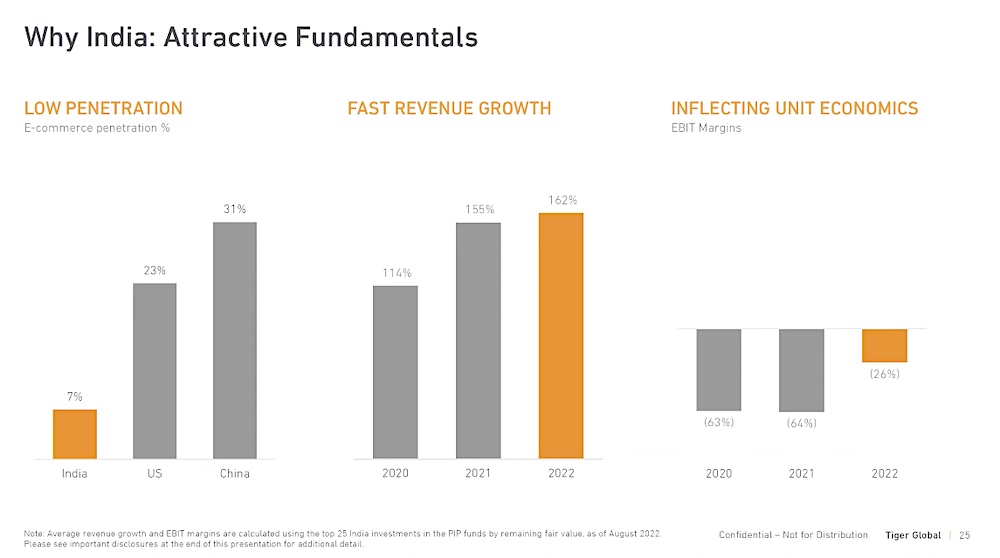
Tiger Global believes India is likely to produce the highest equity returns globally in the future, its partner Scott Shleifer said on an investor call Tuesday, even as he admitted the investor giant has made way more money in China and the U.S.

“We think it will be the best place to invest,” said Shleifer of India. “We were able to purchase 16 or 17% of Flipkart for $8 million in 2010,” he said of the investment in the e-commerce giant, which is currently valued at over $36 billion. “We were able to purchase 10% of Inframarket for $8 million. We purchased a third of Upstox for $50 million.”

Tiger Global is one of the most prolific investors in India and is a backer of over a third of all unicorn startups in the country. The New York-headquartered firm, which counts India among its top three markets globally, has deployed over $6.5 billion in India since inception, TechCrunch reported last year.

India has attracted over $75 billion in investment from tech giants Google, Meta, Amazon and investors such as Sequoia, Tiger Global, Accel and Lightspeed over the past decade. But the country’s burgeoning startup ecosystem has seen very few exits and many consumer internet startups that listed in the past two years are trading significantly below their listing prices.

Shleifer acknowledged that returns on India have not been anything to write home about so far.

“Returns on capital in India have sucked historically. If you look at market leading internet companies whether it is Google, Facebook, Alibaba or Tencent, revenue got bigger than cost more than a decade ago. You had a great legacy of last 17-18 years of materially profitable internet companies. So returns on equity in the internet got really high and the returns for investors have been really high. But that did not happen in India,” he said on the call, which was also attended by Alpha Wave Global co-founder and partner Navroz Udwadia and saw participation from about 200 entrepreneurs, investors and bankers.

Until the past two or three years, India had about zero profitable internet startup even as banks and firms in other industries flourished, said Shleifer. “As a result, returns on capital for investors like us have been below average … way below. Our returns in India is something like 20% gross since inception. That compares to mid-30s in the U.S. on the private side, and low 50s in China. But that’s the past,” he said.

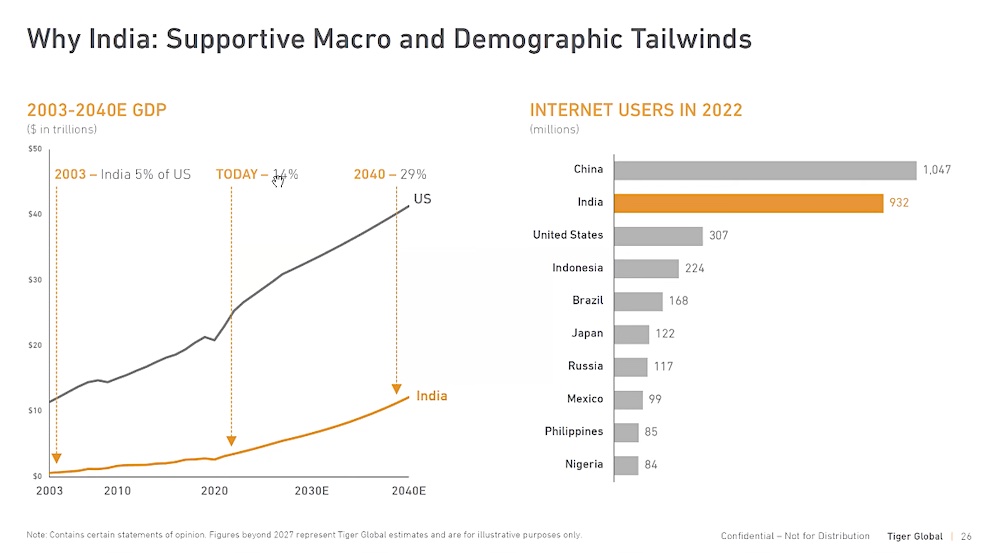
Shleifer asserted that the low returns in India is nobody’s fault, adding that the $3 trillion GDP of the country itself is small. In recent years, he said, “we have seen incremental profit margins on market leaders be fabulous. So this big risk that you would have a great country that would gain share in GDP, but there wouldn’t just be excess profit pools that could have a sustainable competitive advantage, we think the odd of that fallen off a cliff.”

He argued that the historical low returns in India allowed the country entered the downturn better position than the U.S. “You did not have much excess capital in India as there were in few other places.”

Slides from Tiger Global’s presentation:

This is a developing story. More to follow.

Tiger Global’s India returns ‘way below average’ but firm remains bullish, says Scott Shleifer by Manish Singh originally published on TechCrunch


from TechCrunch https://ift.tt/04jg2HE

MUFG, Japan’s largest bank, launches $100M fund for Indonesian startups

MUFG, Japan’s largest bank by market cap, announced today the launch of a $100 million fund focused on Indonesian startups. The fund, a collaboration between MUFG subsidiaries MUFG Innovation Partners, MUFG Bank and Indonesian commercial bank Danamon, is called MUFG Innovation Partners Garuda No. 1 Limited Investment Partnership.

The fund, which is the third one managed by MUFG’s fund management company MUIP, will make strategic investments in startups that can work with Danamon, a commercial bank acquired by MUFG and MUFG Bank in 2019. Danamon’s goals are to increase product competitiveness, promote digitalization and partner with portfolio companies to tap into their customer contacts.

Since its inception in 2019, MUIP has invested a total of more than 40 billion yen (about $307.5 million USD) in startups around the world. The launch of its new fund comes about a month after MUFG invested $200 million in Akulaku, a Jakarta-based fintech. That was also a strategic investment, with Akulaku and MUFG planning to collaborate on tech, product development, financing and distribution.

MUFG has been focused on increasing its presence in Southeast Asia, and earlier this year it purchased the Philippines and Indonesian units of Home Credit BV for €596 million.

MUFG, Japan’s largest bank, launches $100M fund for Indonesian startups by Catherine Shu originally published on TechCrunch


from TechCrunch https://ift.tt/rgDJteK