Shak Lakhani, the 21-year-old chief executive and co-founder of Avro Life Sciences, started researching biomaterials when he was 15 years old.
Every summer and after school the teenager would travel nearly two hours by bus and train from the Richmond Hill neighborhood of Toronto where he lived to the tissue engineering lab at the University of Toronto and develop three dimensional, in-vitro models of tumors using biomaterials.
For three years, Lakhani worked in the lab, before going on to study nanotechnology engineering at the University of Waterloo a short 73 miles away. It was there, in his first year, that Lakhani met another Richmond Hill resident, Keean Sarani, and launched Avro Life Sciences.
Sarani, also 21, had his own history in life sciences. A former epidemiologist who worked as a research assistant at the aptly named Hospital for Sick Children, Sarani spent his high school years working in community pharmacies before going on to graduate from the University of Waterloo with both an Honours Science degree and a doctorate in pharmacy directly from high school.
Sarani and Lakhani, who’re related by marriage, first met in the Village 1 dormitory complex at the University. Within months of their first meeting the two decided to start working on the company that would become Avro.
They formally launched the business in January 2016, a time when Lakhani said the two college students would hold “startup Sundays” where they would pitch ideas to each other in one dorm room or another on Sunday evenings, until they found an idea that seemed viable.
Given their experience — Sarani in pharmacies and treating patients and Lakhani in chemistry and material science, the two hit on the idea of drug delivery and patches.
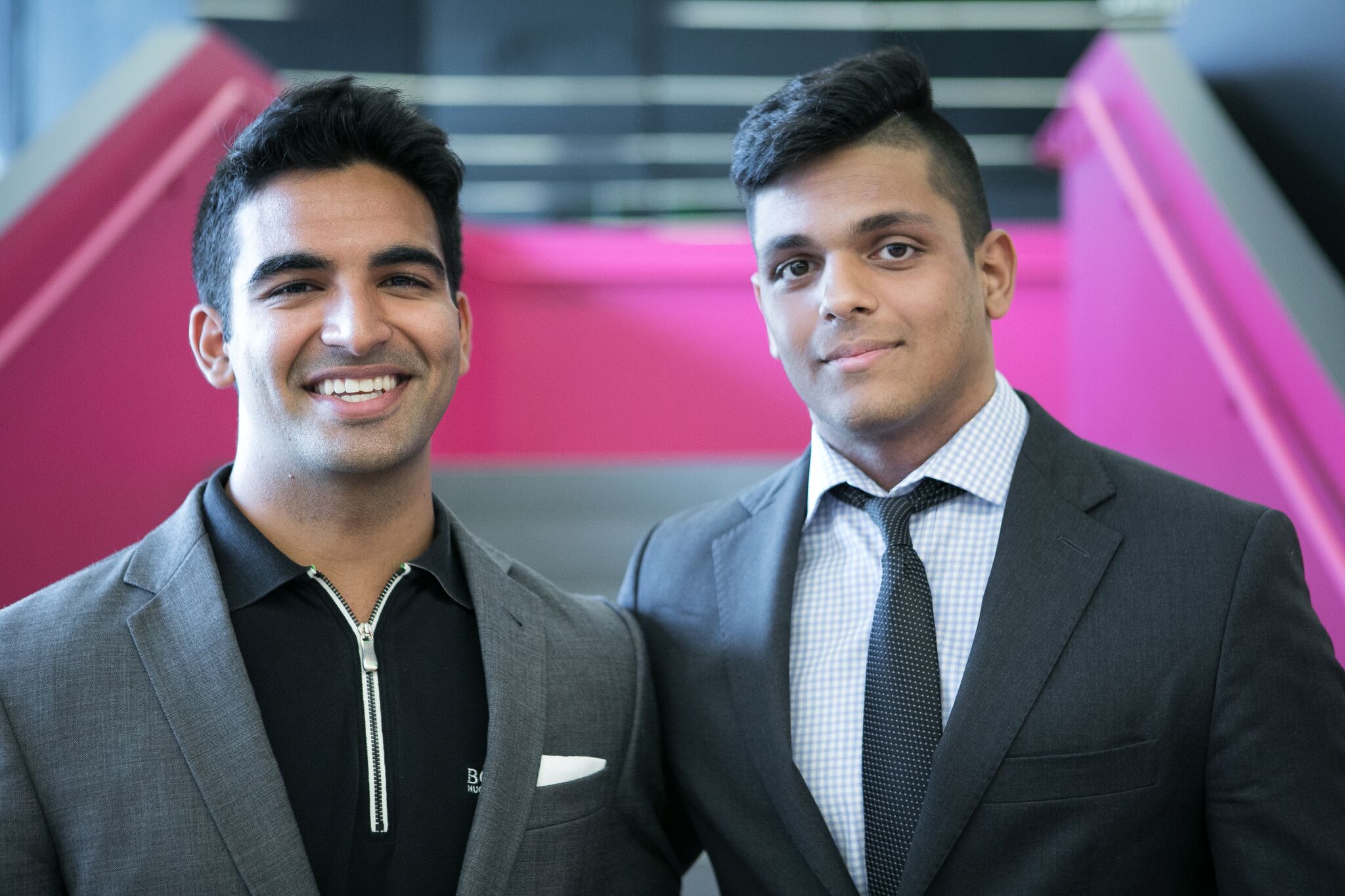
Avro Life Science co-founders Keean Sarani and Shak Lakhani
The two initially toyed with a multivitamin patch for daily health, but through the sniffles, watery eyes, and sneezes of perennial allergy sufferers the two hit on the idea of an antihistamine patch to cure their own ailments.
The two won their first pitch competition three months after hitting on the initial idea in March 2016 and formally incorporated their business in November 2016.
Fast forward two years and the two co-founders are just about ready to make the final preparations for the first product with help from an initial seed round from investors led by Fifty Years, with participation from Susa Ventures, Garage Capital,Heruistic Capital, EmbarkVentures, Uphonest Capital, and Buckley Endeavours. Individual angel investors also participated in the round. In all Avro has about $2.2 million in the bank.
According to Lakhani, the company has already developed a polymer that allows Avro to make patches that can deliver hundreds of different drugs. Now it’s just a matter of gearing up for clinical trials that the company will run before the end of the year.
The first product, Lakhani says, is “a medicated sticker for seasonal allergies.” The company’s plan to get to market involves revitalizing drugs that pharma companies haven’t been able to bring to market because oral delivery is difficult, Lakhani says.
“Really the breakthrough is the [proprietary] combination of materials that can hold all of these different drugs,” he said. “The method of drug delivery is the same as in nicotine patches. In our case as a result of the polymer and manufacturing method…. [the drugs] don’t bond with the polymer. They are micro-adhesives in the patch. Heat from the skin dissolves the polymer and allows the drugs to enter the blood stream.”
Basically, there are tiny bubbles on the patch and contact with (and heat from) the skin causes the bubbles to break and deliver any drugs in an unadulterated form to the bloodstream, Lakhani explained.

Because the company is using generic drugs for its first tests, it’s hoping to have an easier path to market to prove the viability of its delivery system.
Down the road, the company also has some pretty impressive pharmaceutical partners that it could tap. Avro is already working with Bayer as part of their accelerator program in Toronto and that may lead to a deeper relationship down the road, according to Lakhani.
The first drug that the company is testing is Loratadine (a common antihistamine).
“In the coming years, we envision bringing a number of other patches to market for drugs addressing neurodegenerative diseases, cardiac health, analgesics and many more to improve drug delivery and compliance while revitalizing pharma pipelines,” Lakhani wrote in an email. “One day we hope to allow large pharmaceutical companies to ‘rescue’ drugs that they spent billions of dollars developingm, but failed trials due to low bioavailability, high liver toxicity from an entire pill being metabolized at once.”
For Fifty Years co-founder, Seth Bannon, Avro’s technology is a “holy grail” for drug delivery that can save pharmaceutical companies billions of dollars.
“The market for this is absolutely massive. Initially, Avro can manufacture and sell patches carrying generics direct to consumer to address issues like compliance with children and the elderly,” wrote Bannon, in an email. “Because Avro can deliver many drugs transdermally… When you deliver drugs transdermally, you significantly reduce liver toxicity and boost bioavailability. This means pharma can rescue drugs that just barely failed in Phase III. Pharma will pay a lot for this.”
from TechCrunch https://ift.tt/2lJRmqw