Wednesday, October 31, 2018

Twitter’s spam reporting tool now lets you specify type, including if it’s a fake account

Twitter is adding more nuance to its spam reporting tools, the company announced today. Instead of simply flagging a tweet as posting spam, users can now specify what kind of spam you’re seeing by way of a new menu of choices. Among these is the option to report spam you believe to be from a fake Twitter account.

Now, when you tap the “Report Tweet” option and choose “It’s suspicious or spam” from the first menu, you’re presented with a new selection of choices where you can pick what kind of spam the tweet contains.

Here, you can pick from options that specify if the tweet is posting a malicious link of some kind, if it’s from a fake account, if it’s using the Reply function to send spam, or if it’s using unrelated hashtags.

These last two tricks are regularly used by spammers to increase the visibility of their tweets.

Often, high profile Twitter users will see replies to their tweets promoting the spammers’ content. For example, check any of @elonmusk’s thread for crypto scammers’ tweets – a problem so severe, that when Elon played along one time as a joke, Twitter locked his account.

Using hashtags, meanwhile, allows spammers to get attention from those people searching Twitter’s Trends.

And of course, spammers are often posting prohibited content, like malicious links, links to phishing sites, and other dangerous links.

But Twitter users will probably be most interested in the new option to report fake accounts.

There’s been a lot of name-calling on Twitter today following the emergence of reports of Russian bots and trolls flooding Twitter, in an attempt to influence U.S. politics with disinformation. Often, users in disagreements on the site will call someone “bot” as a way to shut down a conversation.

Twitter itself has been suspending real bots left and right in recent months. It deleted 200,000 Russian troll tweets earlier this year, for example, and suspended more than 70 million fake accounts in May and June, according to reports.

Now users will be able to report those accounts they believe to be bots, as well.

To what extent Twitter will rely on these user-generated reports over its own algorithmic-based bot detection systems, or other factors (like IP addresses or suspicious behavior), is unclear.

It’s also unclear if people can ban together to mass report an account as “fake” in an attempt to remove a real person’s account. But someone will surely soon test that out.

Prior to the change, users were able to report spam but not the type of spam, Twitter’s documentation today still confirms.

Twitter tells us the updated reporting flow will simply allow the company to collect more detail so it can “identify and remove spam more effectively.”


from TechCrunch https://ift.tt/2AE1HwA

Sign up for Spotify’s $15/month plan, get a free Google Home Mini

Spotify’s got a new promotion to entice users to sign up for a Premium Family plan. Commit to $15 a month for up to six members, and the streaming service will toss in a free Google Home Mini.

It’s an interesting promotion from the standpoint of Spotify and Google’s growing partnership. While Google’s long had its own music streaming service under the Play banner, it’s failed to set the world on fire. As such, the company has long let users choose their default service when setting up a Google Home device.

Spotify, of course, doesn’t have the sort of smart home infrastructure of its largest competitor, which puts the company at a kind of disadvantage as it attempts to maintain its marketshare lead, while Apple Music continues to grow. The deal marks both an easy promotion for Spotify and an attempt to help establish its place as part of the growing connected home ecosystem. For Google, it’s yet another opportunity to get its entry level smart speaker into more homes.

Also, hey, free Home Mini.

Both new and existing subscribers can take advantage of the promotion, which runs through the end of the year.


from TechCrunch https://ift.tt/2SAfviP

Daily Crunch: Waymo can go driverless in California

The Daily Crunch is TechCrunch’s roundup of our biggest and most important stories. If you’d like to get this delivered to your inbox every day at around 9am Pacific, you can subscribe here:

1. Waymo, take the wheel: Self-driving cars go fully driverless on California roads

The Alphabet-owned company has been testing on public roads for years now. But this permit, issued by the California Department of Motor Vehicles, allows Waymo to test these self-driving cars without a human driver behind the wheel.

Waymo said its driverless test cars will initially hit the streets near its Silicon Valley headquarters, including parts of Mountain View, Sunnyvale, Los Altos, Los Altos Hills and Palo Alto.

2. Facebook bans the Proud Boys, cutting the group off from its main recruitment platform

We reported in August that the Proud Boys operate a surprisingly sophisticated network for getting new members into the fold via many local and regional Facebook groups.

Photo Credit: Susan Watts/NY Daily News via Getty Images

3. Up close and hands-on with the new iPad Pro

The new Pro, which Apple unveiled yesterday, marks what is arguably the single largest design change to the iPad line in its eight-and-a-half-year existence.

4. Facebook shares climb despite Q3 user growth and revenue

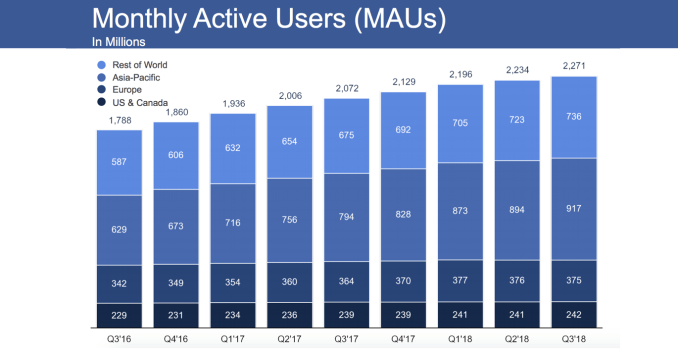
The social network stumbled again in Q3, but shares climbed after its latest earnings report, thanks in part to Facebook’s $5.14 billion profit and the addition of 1 million users in North America.

5. Twitter’s doubling of character count from 140 to 280 had little impact on length of tweets

According to new data released by Twitter, only 1 percent of tweets hit the 280-character limit, and only 12 percent are longer than 140 characters.

6. Apple pulls WatchOS 5.1 update after it bricked some Apple Watches

If you’re an Apple Watch owner having trouble finding the shiny new WatchOS 5.1 update, turns out it isn’t quite ready yet.

7. Starship is using self-driving robots to deliver packages on demand

Once your package arrives at a local Starship facility, the app will notify you. Then you can request a Starship bot that will deliver the package to you, wherever you are.


from TechCrunch https://ift.tt/2OYA8qC

How the Apple Watch changed the world

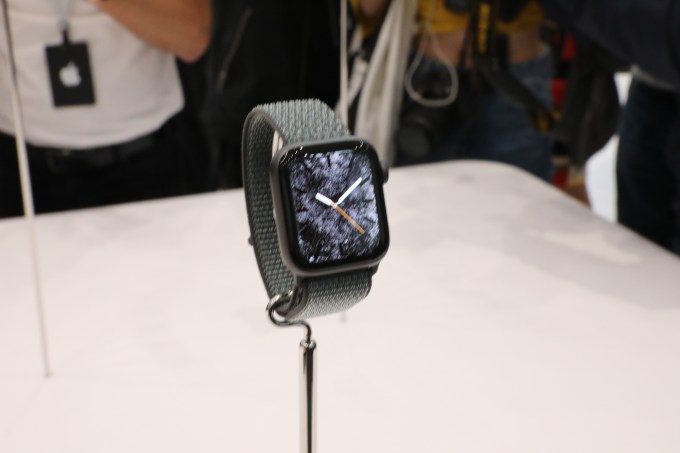
In 2015 Switzerland was fucked. This blunt belief, grunted out by Apple’s Jony Ive and repeated by the media as a death knell for the watch industry, seemed to define a sad truth: that the Swiss watch was dead and Apple pulled the trigger.

Now, three years and four Apple Watches later, was Ive right? Did Apple change the world? And, most importantly, did Switzerland survive?

Yes, but…

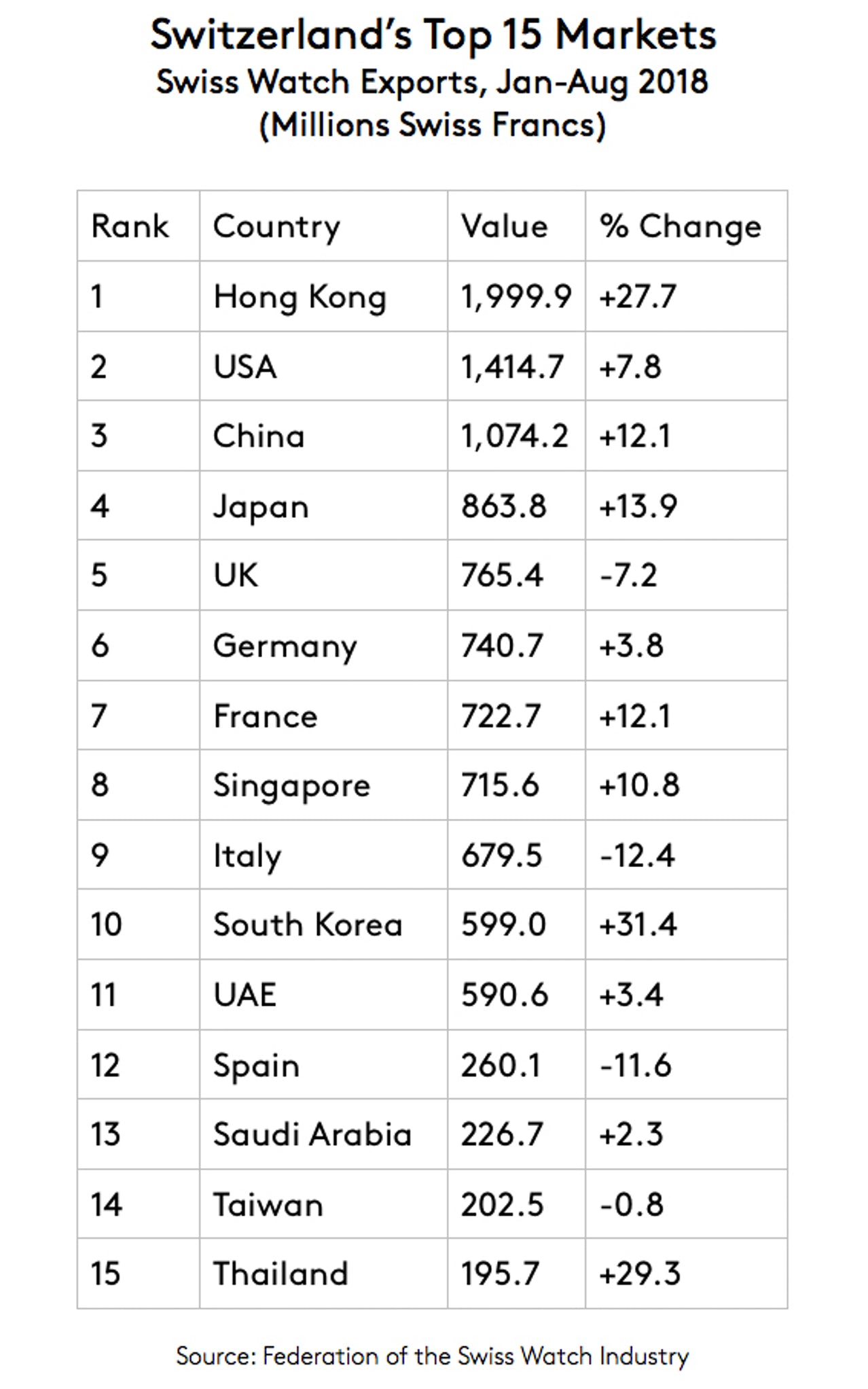
As you might have noticed the Swiss watch industry is still standing. The major Swiss houses – LVMH, Richemont, and Swatch Group – are seeing a major uptick in sales, especially in the US. According to the Federation of the Swiss Watch Industry, sales are up 5.5% year-over-year, a bit of news that was, amusingly, almost buried by the onslaught of Apple Watch Series 4 reviews.
This increase of US sales bucked a major trend this year and one market insider, who preferred to remained anonymous, noted that all of his sales contacts are seeing increased sales in the $3,000 and above watch category. While the low-cost fashion watches were, as he said, “decimated,” the luxury market is growing. But why?

According to Swatch Group, Swiss watch exports rose 4.8 percent compared with last year and, according to a Reuters report, “first-quarter watch exports rose 10.1 percent, the highest quarterly growth rate since mid-2012, according to figures from the Federation of the Swiss Watch Industry.”

“You know we saw an end of the year that was very strong – double-digit growth – and now it continues, so every month is a record month for us,” Swatch Group CEO Nick Hayek told CNBC. In short, the industry is back from an all-time low after the recession.

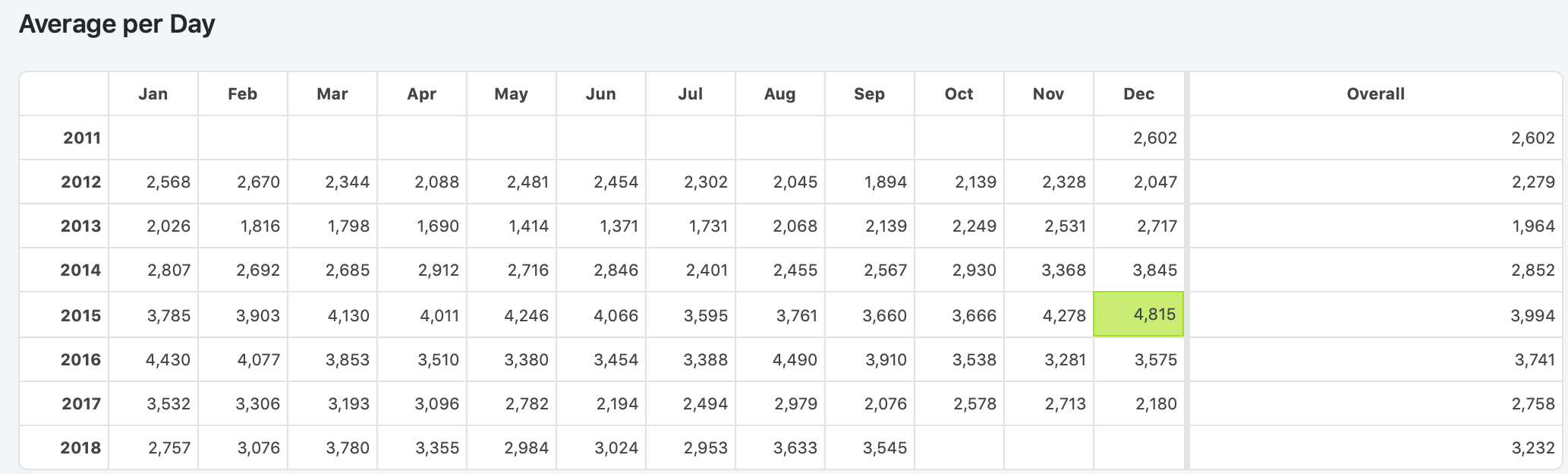
Watch analysts believe that Apple created a halo effect. Of the millions of people who bought and wore an Apple Watch, a majority had never worn or thought about wearing a watch. Once they tried the Apple Watch, however, and outfitted it with leather bands, fancy Milanese loops, and outfit-matching colors the attitude changed. If wearing watches is so fun and expressive, why not try other, more storied pieces? The numbers are hard to find (watchmakers are notoriously secretive) but I’ve found that my own watch obsessives site, WristWatchReview, saw a solid uptick in traffic in 2015, one that continued, for the most part, into 2018. One year, 2017, was considerably lower because my server was failing almost constantly.

What does this mean for the watch? First, it means that, like vinyl, a new group of obsessives are taking up the collector’s mantle after discovering the implicit value of more modern forms of the same thing. An Apple Watch is a gateway drug to a Tissot which is a gateway drug to a classic tropical Rolex Submariner on a signed band just as your first Radiohead MP3 leads to buying a turntable, an amp, a Grado cartridge, and a pressing of Moon Shaped Pool.

“In high school I wore a pebble for a while,” said Brady, a 20-year-old college sophomore I spoke to. “As an easily-distracted high school student, even though this wearable was very primitive tech, it consumed a lot of my attention when it wasn’t appropriate to be on my phone – which meant also not appropriate to be on my watch. I then shifted to Nixon quartz ‘fashion watches ‘and i was happy knowing they kept good reliable time. Then I got a Seiko SNK805 automatic. I don’t have a single non-mechanical watch due to my respect for the craftsmanship!”

Wearables are changing, as well, pushing regular watches back into the spotlight. As Jon Speer, VP at Greenlight.Guru, most wearables won’t look like watches in the next few years.

“I predict the next generation of wearables to blur the lines between tech accessory and medical device. These ‘devices’ will include capabilities such as measuring blood pressure, blood sugar, body temperature and more,” he said. “The FDA is working closely with industry partners to identify common roadblocks to innovation. The De Novo Program, the classification Apple pursued for the Apple Watch, is the category for medical devices that don’t fall within an existing classification. As we blend medical technology with consumer technology, I foresee the De Novo program being utilized by companies such as Fitbit and Garmin. As a consumer, I’m very excited for the potential and advancements.”

Thus the habit of wearing watch might stick even as the originators of that habit – a little square of steel and glass strapped to your wrist – disappears.

Could it all be a mirage?

The new Apple Watch is very positively reviewed and Android Wear – as evidenced by companies like Montblanc selling very capable and fashion-forward smartwatches – is still a force to be reckoned with. Further, not everyone falls back into watch wearing after trying out the thing Jony Ive said would fuck Switzerland.

Watches are an acquired taste like craft beers, artisanal teas, and other Pinterest-ready pursuits. Sometimes simply strapping one to your wrist isn’t enough.

“I got the first gen Apple Watch,” said entrepreneur David Berkowitz. “I loved it, and then I stopped wearing it a bit. As I did, I lost the charger and never bothered replacing it. I haven’t worn it since and haven’t seriously considered getting a new one.”

“I’m just not that customer,” he said.


from TechCrunch https://ift.tt/2Deo7ah

LG will unveil its foldable smartphone during CES 2019

Clearly, next year's big thing will be foldable devices and LG wants in. Samsung promised to announce its flexible Galaxy phone soon, but its local rival might even beat it. According to the latest tweet from Evan Blass LG is looking to unveil its revolutionary smartphone at its own keynote at CES 2019. I can't speak for Samsung......but I do know that LG plans to unveil a foldable phone at its 2019 CES keynote.— Evan Blass (@evleaks) October 31, 2018 Going by the patent that got approved by the US Patent and Trademark Office in late 2017, the smartphone will most likely fold...


from GSMArena.com - Latest articles https://ift.tt/2JscL2z

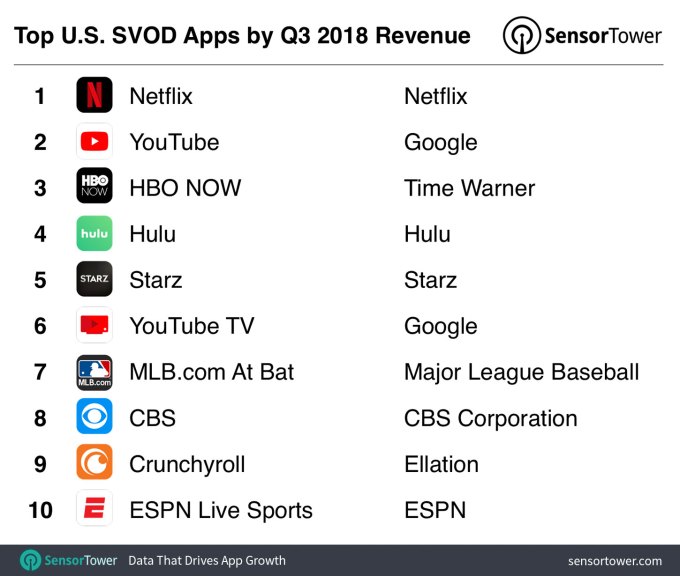
Consumers spent $329M on the top 10 subscription video apps last quarter

Last year, the top subscription video apps like Netflix and Hulu raked in a combined $781 million, and that trend is showing no sign of slowing down in 2018. In the third quarter of 2018, U.S. consumers spent an estimated $329 million in the top 10 subscription video-on-demand apps across the App Store and Google Play – a figure that’s up 15 percent from the $285 million spent in Q1.

The data is the latest in a new report from app intelligence firm Sensor Tower, which has been following the growth of subscription video apps for some time. Last year, for example, it found that Netflix’s app topped the charts in terms of revenue, when compared with all the other non-game apps on the market.

Netflix hasn’t fallen from its top ranked position, the new data shows. In fact, it’s continuing to grow.

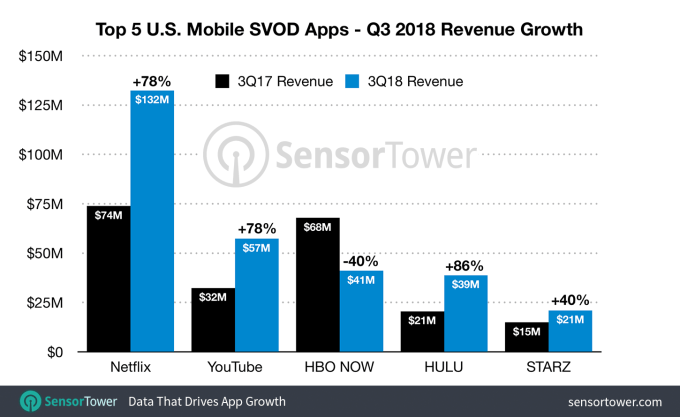
The app pulled in an estimated $132 million in consumer spending across the app stores in Q3, which is up 78 percent from the $74 million spent in the third quarter of 2017.

However, Hulu is now growing faster, the report found. It saw subscription revenue jump 86 percent to $39 million, up from $21 million a year ago.

It seems some consumers may have made the move to Hulu thanks to the extra cash they had on hand, thanks to dropping their HBO subscription.

The only subscription video app that saw revenue decline in Q3 was HBO NOW, which took in $41 million in the quarter, down 40 percent from the $68 million in Q3 2017. But notably absent this quarter was the network’s biggest draw, “Game of Thrones,” which had been airing at this time last year. A drop was expected.

The top grossing chart of these subscription video apps for Q3 2018 looks very similar to last year’s in terms of the apps included, and sometimes, even their rankings.

But two services made moves, the report says.

YouTube TV jumped from $3 million in the year-ago quarter to $16 million in Q3 on Apple’s App Store, thanks to its expanded market penetration and consumer adoption. And ESPN Live Sports, which added in-app subscriptions in Q2, grossed $4.6 million in the third quarter, up 119 percent from Q2.

Even CBS is doing well, despite the fact that not everyone loves the new “Star Trek.”

Still, it appears CBS made a good move by betting on fans’ devotion to the franchise, as U.S. consumers spent $6 million in the app in Q3 2018, up 50 percent from the $4 million spent in Q3 2017.

The report’s data includes subscription revenues only, not refunds or in-app advertising revenues, Sensor Tower notes.

The broad increases in consumer spending on these video apps is yet another example of the significant and growing subscription business – much of which is taking place on mobile. Subscriptions accounted for $10.6 billion in consumer spend on the App Store in 2017, and are poised to grow to $75.7 billion by 2022, an earlier report found.

However, the top subscription apps aren’t all video apps. Others that consistently rank highly in the U.S. include Tinder, Spotify and Pandora, for example. Currently, the top grossing chart for the App Store includes a number of non-games, like Netflix (#1), YouTube (#2), Tinder (#3), Pandora (#4), Hulu (#7), and Bumble (#8).


from TechCrunch https://ift.tt/2OYMbnK

Google Pixel 3 review

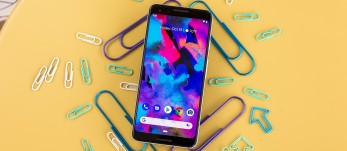
Bringing the small Pixel into the now with a tall display and less wasted space, we have this year's Google Pixel 3. Updated glass build and a couple of selfie cameras mark the other key changes compared to the 2017 vintage.


from GSMArena.com - Latest articles https://ift.tt/2DdWkqw