Monday, December 31, 2018

Are rightsholders ready for public domain day?

On January 1, 2019, the New Year will ring in untold numbers of additions to the public domain in the U.S., including hundreds and maybe thousands of works with at least a small public reputation. This, of course, is due to the expiration of the terms of their copyrights, some of which have been extended multiple times since the 1960s. 

This is a good thing from many perspectives, including that of authors, publishers, museum curators, teachers, old-book readers and music and film buffs. It possibly may be a slightly bad thing for a few people — primarily certain estates representing long-dead authors and other creators.

What’s a “term” in the context of copyright?

The duration, or term, of U.S. copyright is set by Congress, and has gradually crept up over time from the original 14 years (plus 14 more if the author was still alive and renewed the copyright) — in Thomas Jefferson’s time — to a whopping “life of the author plus 70 years,” as set by the 1998 “Copyright Term Extension Act” (CTEA, which extended it from life plus 50).

For works first published between 1909 and 1978, the maximum term was finally set by Congress at 95 years (assuming the author complied with a whole lot of rules, alluded to below).  And for post-1978 works, in instances where the author/creator is not a human being (such as a business commissioning a “work made for hire” under rules developed in the case-law) or the work was published under a pseudonym for an unknown person, the term can be as long as 120 years! The copyright in a work, duly registered at the time that registration was required (pre-1978), may never have been renewed, and so its protection may have quietly lapsed some time ago; for many more obscure works, it’s hard to know.

Fun fact: This Copyright Term Extension Act is also known as the Sonny Bono Copyright Term Extension Act. Congress named it in memory of the composer of “I’ve Got You, Babe,” who, as a member of Congress from Southern California, was among the authors of the bill; he unfortunately happened to die while it was being worked on in committee. Prior to 1978, the term of U.S. copyrights was determined by fixed terms of years, subject to publication, registration and notice requirements. Here are more details on that.

How do works pass into the public domain?

Currently, works pass into the public domain according to a complex schedule, combining (sometimes awkwardly) the rules of various laws implemented over the past century.

Bear in mind, however, that many works have passed (or “fallen” or “lapsed,” as the older phrases had it) into the public domain in the U.S. for reasons other than term expiry, even during the 20 years of the CTEA extension. According to the law in effect prior to 1978, if the work was published but never registered in the U.S. Copyright Office, it did not receive protection under copyright law; a work might also not be protected by U.S. copyright law if it lacked proper notice — the © symbol and the proper wording — or if the work’s registration was not renewed after its first 28-year term expired. Or if, as a work of the federal government, it never enjoyed copyright protection in the first place.

Qui Bono? (get it?)

As it turns out, it is not just re-publishers of “classic” texts, such as Dover Thrift Editions, which benefit when new works become available. Textbook and educational publishers frequently re-use old short stories and essays in larger collections, and a work of marginal utility might become more attractive as a potential addition to these collections once the cost of clearing the rights is reduced.

For example, a few years ago a 1922 story by F. Scott Fitzgerald, “The Curious Case of Benjamin Button,” (whose U.S. copyright had lapsed) was adapted into a feature film. To me, the lesson to be gleaned is that many works of the early 20th century still appear to bear some cultural cachet (or at least continuing value to society) — such that more no-cost access to these works (by their passing from copyright protection to the public domain) should have the overall effect of helping them find new audiences.

Note: Bear in mind, all of these examples are simply illustrative — without a full and careful copyright search, it is difficult to be certain of the copyright status of almost any work. On that, more below.

New works coming into the U.S. public domain also will have the effect of giving researchers new texts to run Text and Data Mining (TDM) algorithms across. It also may add to the richness of film and cultural studies.

Mark Twain proves this isn’t so easy

Unfortunately, determining when a work has in fact “fallen” into the public domain due to the term of its copyright having expired is not always as simple as one might hope.

For example, one might think that everything ever laid down by the pen of Mark Twain (S.L. Clemens, d. 1910) would be in the public domain by now. But, since he left a treasure trove of unpublished works, their copyright protection has extended for many years after his death, because, under pre-1978 law, those works’ copyright protection would not start until the works were published. The distinction between published and unpublished works has been discarded under post-1978 law, but won’t be fully effective for another 30 years. So, some items in the microfilm edition of Twain’s letters and manuscripts (their first publication) are still considered to be under copyright. He’s also enjoyed considerable success recently with the full and final publication of his autobiography.

Twain, a student of intellectual property, steadfastly argued for a perpetual copyright, but he came to realize that this was not permitted under the copyright clause of the U.S. Constitution, which refers to “securing [protection] for limited times.” But, in an age when copyright only protected works for which registrations had been obtained, he did point out that most books wouldn’t be affected by a longer term at all — for the vast bulk of them had no commercial life remaining to them a very few years after their initial publication:

One author per year produces a book which can outlive the forty-two-year limit; that’s all. This nation can’t produce two authors a year that can do it; the thing is demonstrably impossible. All that the limited copyright can do is to take the bread out of the mouths of the children of that one author per year.

I made an estimate some years ago, when I appeared before a committee of the House of Lords, that we had published in this country since the Declaration of Independence 220,000 books. They have all gone. They had all perished before they were ten years old. It is only one book in 1000 that can outlive the forty-two-year limit. Therefore, why put a limit at all? You might as well limit the family to twenty-two children.

– S.L. Clemens, in testimony to Congress, concerning proposed copyright legislation (1906)

“Forever minus a day,” another idea which has been occasionally bruited about (particularly by Congressman Bono and his widow, who was later elected seven times in her own right to Congress), would not constitute much of an effective limit, and so would, I believe, violate the Constitutional limitation; 95 years (an estimated average of the “Life plus 70” term) seems closer to a natural lifespan for a copyright — to me at least. If you and your heirs somehow can’t get the commercial value out of your work before nearly a century is out, I think there’s a takeaway lesson there.

On the other hand…

… some works do have cultural lifespans exceeding the term of copyright. The estates of certain literary, film and musical creators may stand to lose when the copyright in some of the works in their respective repertories lose copyright protection due to the lapse of their terms. For some examples of works entering the public domain on January 1, 2019, that may still have financial value to the author/creator’s heirs: Hemingway’s “Three Stories and 10 Poems” was first published in 1923; it was also the year of release for “Safety Last!” a silent film from Hal Roach Studios, starring Harold Lloyd, which many people remember. The same year saw the first publication (of the sheet music) for “Who’s Sorry Now?” which was a hit recording for Connie Francis in 1958.

But, on balance, “Nothing gold can stay,” as Robert Frost observed in a poem slated — I’m pretty sure — to enter the public domain on January 1st.* The reading, listening, and viewing public should expect to be the main beneficiary of these works entering the public domain. Indeed, 95 years is a good run for the commercial exploitation of a work. Now it’s everybody else’s turn to benefit.

*If it hasn’t already. Copyright searches, on the detail level, can be quite difficult and time-consuming. See: https://www.copyright.gov/rrc/. For any proposed commercial republication, it is certainly the course of wisdom to consult with an attorney and have a full copyright search done.


from TechCrunch https://tcrn.ch/2s44j1S

Soulja Boy’s game consoles pulled from store weeks after launch

As anyone from the Gizmondo to the Virtual Boy can tell you, it’s tough to launch a console. Of course, it’s helps when your device apparently comes pre-loaded with thousands of games from big name companies like Nintendo, Sony, Square and Bandai.

It was clear the moment they were launched that Soulja Boy’s SouljaGame console and handhelds were too good to be true, in spite of his insistence that he’d struck deals with game publishers. Now, around three weeks after launch, both have been pulled from his online store (which also stocks a…familiar looking wearable and headphones).

What caused the systems to be pulled from his site isn’t clear, though the rapper appears to have acknowledged as much in a tweet, stating, “I had to boss up, I didn’t have a choice.” Of course, given Nintendo’s history, it seems unlikely that a deal was struck to license titles to what appears to amount to a rebranded emulator.

As Variety notes, titles like Tekken and Tomb Raider were also features in ads for the systems, which is practically crying out for publishers to intervene. Meantime, he’s promised “big plans” soon, including his already stated intention to launch an eSports team at some point next year. For now, however, the rapper appears to be doing just fine, thank you very much:


from TechCrunch https://tcrn.ch/2EYQ0mY

Here’s what to expect in cybersecurity in 2019

Around this time every year, my inbox fills with the same repetitive junk.

“Would you consider putting [any random company] in your gift guide?”, “are you going to CES and if so can I pitch you [a gadget that literally won’t be around this time next year]?”, and, “do you want to cover [a company you’ve never hard of’s] predictions for next year?”

To which I always respond: “No,” “absolutely not” and “predictions are not news.”

The “predictions” emails piss me off. Most of the companies that offer predictions don’t seem to fully understand the security field outside their particular niche, or worse, have an agenda they’re trying to push. This year was no different. I trawled through my inbox, scanning literally dozens of emails pushing “predictions” for the coming year.

“Artificial intelligence will stop a data breach,” said one email. “The supply chain will face more attacks,” said another. And, my personal favorite, “bad actors will combine multiple attack types to create synergistic super threats.”

Hate to break it to you, but “super threats” are not a thing.

If you thought 2018 was a tough year for tech, 2019 is going to be so much worse. The groundwork we laid this year will roll over into the next, and that’s when things will start to hit hard, from new laws and political (in)decisions to privacy issues and how employees — not companies — will start to call the shots.

Here’s what you need to know for 2019 in security.

Expect more data leaks and exposures — but not just breaches

2018 saw a rising trend in data leaks and exposures — specifically data that’s not protected with even the most basic security, like a password.

We’ve seen a ton of sites and services exposed in the past year — from gym booking sites, anonymous social network Blind, Urban Massage, FedEx, Canadian internet provider Altima, Amazon and fitness app Polar, to name a few.

Exposed databases and user data can be easily found, yet are entirely preventable — often simply by setting a password. Breaches, where a hacker exploits a vulnerability, are more difficult and require some level of skill, making them less common. But human error, a lack of security smarts or just sheer laziness makes exposed data more discoverable, and yet there’s no sign of data exposures dying down any time soon.

California’s privacy rules will come to a head

After a long fight, California passed its consumer privacy law — set to go into effect at the end of 2019.

Think of the law as like GDPR for California, which will mandate that companies disclose how they collect user data and what they do with it. The law will allow authorities to impose fines on companies that don’t comply or which violate the rules. It’s particularly important for consumers, given most of the world’s largest tech companies have their headquarters in the state.

Tech companies opposed the law. After spending collectively billions of dollars to comply with GDPR, many didn’t want to face another hefty bill to comply with more privacy rules. Instead, many companies pushed for a federal law to overrule and upend California’s soon-to-be-enacted rules. With enough lobbying power in Washington, DC, tech companies and telcos want lawmakers to roll out weaker legislation.

With almost exactly a year to go before California’s rules are set to go into effect, expect to see Silicon Valley work together — for once — to get their own way at a federal level.

Brexit will hamper U.K. tech, startup growth

Brexit, the U.K.’s departure from the European Union, is set for March 29 — and all signs point to a “no deal” that will cause serious, if not as of yet untold problems with immigration, trade, and even intelligence sharing and security arrangements with the U.K.’s European partners.

Leaving the EU without any trade or immigration deals in place will hurt startups and the wider tech scene. Attracting good overseas talent will be difficult without knowing what the immigration rules will be. Even practical things like GPS will begin to struggle, as well as data transfers in and out of the U.K. without a deal in place once the U.K. goes over the cliff-edge. It’ll be a nightmare for companies trying to comply with what’s left of the EU data protection and privacy laws.

Certain technology industries will see more trouble than others, like the gaming industry, which contributes £2 billion ($2.5 billion) to the U.K. economy every year. And, startups won’t get off easy either.

Australia’s draconian encryption laws will begin to hurt

Following in the footsteps of the U.K., Australia passed an anti-encryption law that compels companies operating in the country to turn over encrypted data on request from several government departments.

Many U.S. tech companies, including Apple and Cisco, called on the Australian parliament to ditch the proposals for fear that the law could be abused or harm its customers’ privacy. That didn’t stop a bipartisan effort to pass the bill in time for the Christmas break.

Some companies have already said they can’t — and therefore won’t comply. Signal, the encrypted messaging app, said in a blog post that it “can’t include a backdoor in Signal,” despite the mandate from the country’s capitol. Other companies will find themselves facing the same dilemma. It might force companies to think about their presence in the country altogether.

Facebook’s privacy woes will spread to other Silicon Valley giants

Silicon Valley is split largely into two camps: your data for money, or your data doesn’t make money. You have Facebook, Google and to a lesser degree Twitter and Snap in the first bucket — then you have mostly hardware makers, like Apple, chip manufacturers like AMD and Intel and computer makers like HP and Dell in the other.

Facebook had scandal after scandal this year, after years of playing fast and loose with users’ data. Facebook claims it doesn’t sell your data, but it made money from it at every opportunity. And when it wasn’t actually selling access to your data, it was giving it away.

Many have wondered why other data-hungry, ad-focused companies haven’t had their reckoning yet — and many are asking the same questions. Facebook may be one of the biggest consumers of user data going, but it’s not the only one in the game. In making some of the world’s largest social networks and ad platforms, these companies have inadvertently become mass surveillance tools — either for governments with access already, or hackers and nation states that punch their way through the company’s defenses.

Their time will come — and hot on the heels of Facebook’s slew of scandals, expect it to be sooner rather than later.

Employees, not companies, will dictate how the technology they build is used

This year saw a resurgence of tech employees rising up against their employers for — in their eyes — misusing the products, services and technologies they made for uses outside their moral parameters.

Amazon employees complained that the company’s facial “Rekognition” shouldn’t be sold to law enforcement after the technology was found to racially discriminate against African-Americans. Microsoft staff complained that the company had a $19 million contract to serve U.S. Immigration and Customs Enforcement, during a time where the agency was separating children from their asylum-seeking parents at the border. And Google employees complained when they found that the technology they helped to build would go on to serve Chinese users that enables state surveillance.

Now it’s employees who are trying to call the shots. So far, they’ve had mixed success. Amazon executives didn’t care; neither did Microsoft’s — but Google buckled. Given it’s the talented folk at the companies that make the products, they believe they have a right to say how their products are used and who gets them.

This isn’t something likely to change in the new year, as the government continues to rely on tech companies for enforcement and surveillance. Whether they will be successful, however, will be something to watch.

One incident away from sparking another Apple v. FBI crypto-war

Two years ago, the Apple v. FBI dispute could have taken a completely different path. The FBI was pushing a legal challenge that would forever undermine encryption protections — making it easier for the government to compel companies into complying with orders to undermine their own software security. This year, we saw the government approach Facebook to force the company to rewrite its Messenger app to allow federal agents to wiretap calls. It was all in secret — and only became public thanks to leaks.

We’re still dangerously close to another “crypto-war” (that’s “crypto” for cryptography) that could result in heavy-handed legislation or a legal precedent.

Nobody wants a mass casualty event. But as with San Bernardino and the apparent threat from MS-13 — whether inflated or not, lawmakers and prosecutors use bodies as a bargaining chip to push for more access to our data under the guise of preventing another national crisis.

Gloves are off for U.S. and China in cyberspace — again

The 2015 pact between the U.S. and China that promised to curb each others’ cyberespionage efforts amid rising tensions and escalating attacks between the two nations was delicate and frail, but it was almost inevitable that it would fall apart someday.

In December, when the Justice Department accused two Chinese spies of conducting state-backed hacking on dozens of U.S. companies and government departments, including the Navy, the gloves were off, and the pact was over. The writing was on the wall for a while. Security firm FireEye said in its look-ahead at 2019 that China’s reorganization of its offensive cyber operations units “will inform the growth and geographic expansion of Chinese cyber espionage activity through 2020 and beyond.”

In other words, expect the U.S. and China to begin sparring in cyberspace again.


from TechCrunch https://tcrn.ch/2SuWrlw

Samsung Galaxy M10 FCC certification reveals 6-inch display, 3,400 mAh battery

The FCC has put the upcoming Galaxy M10 through the paces of its certification process, a necessary step prior to launch. This has revealed a few more details about the smartphone that will be the entry level model in Samsung's new M series. The M10 will sport a 6-inch display and a 3,400 mAh battery. Its length and width are 155.7mm and 75.8mm, respectively. According to a past outing in a benchmark's online database, the phone is powered by the Exynos 7870 chipset, paired with 3GB of RAM and 16 or 32GB of expandable storage. The new device is probably going to launch running Android...


from GSMArena.com - Latest articles http://bit.ly/2C23VFN

Report: Amazon is planning a Whole Foods expansion to benefit Prime Now

Amazon is planning a Whole Foods expansion in the U.S., according to a report by The Wall Street Journal published this weekend. The goal is to put more customers within the range of Amazon’s two-hour Prime Now delivery service, including those in suburban areas outside cities, as well as those in regions where the grocer has yet to establish a presence.

Currently, Amazon’s Prime Now delivery service offers two-hour delivery in over 60 U.S. cities, and thirty minute-plus grocery pickup in nearly 30 cities. Amazon is planning to expand those services to almost all its 475 Whole Foods stores, the report said, citing sources.

The retailer will also continue to use perks for Prime members to acquire and retain customers, much as it does today.

Because of its lack of a brick-and-mortar footprint, many U.S. consumers living in the outskirts of cities or in more rural areas don’t have access to Amazon’s Prime Now two-hour delivery service. However, they do have access to Walmart stores, which today offering their own online grocery shopping service with pickup and delivery options in a number of markets.

Walmart says that 140 million customers shop its stores weekly, and 90 percent of Americans today live within 10 miles of one of its locations. That makes it a significant challenger to Amazon in terms of offering fast delivery and pickup options. It also doesn’t require an annual membership.

Other companies are competing with Amazon on same-day delivery, too, including Instacart and Target’s Shipt. Target is also rolling out a curbside pickup service called Drive Up, and is planning to expand Shipt’s assortment and reach in 2019.

The WSJ report didn’t confirm store locations, but did note Amazon was scouting retail spaces in parts of Idaho, southern Utah and Wyoming. Some of these were slightly larger than average Whole Foods stores, at 45,000 sq ft. – which hints at their ability to operate as a hub for delivery and pickup, in addition to being a traditional grocery store.


from TechCrunch https://tcrn.ch/2EZzTWS

Popsugar’s Twinning app is leaking everyone’s uploaded photos

I thought the worst thing about Popsugar’s Twinning tool was that it matched me with James Corden.

Turns out, the hundreds of thousands of selfies uploaded to the tool can be downloaded by anyone who knows where to look.

The popular photo matching tool taking the web by storm is fairly simple. “It analyzes a selfie or uploaded photo, compares it to a massive database of celebrity photos to find matches, and finally gives you a ‘twinning percentage’ for your top five look-alikes,” according to Popsugar, which developed the tool. Then, you share those matched photos on Facebook and Twitter so everyone knows that you don’t look at all like one of the many Kardashians.

All of the uploaded photos are stored in a storage bucket hosted on Amazon Web Services. We know because the web address of the bucket is in the code on the Twinning tool’s website. Open that in your web browser, and you’re looking at a real-time stream of uploaded photos.

We verified the findings by uploading a dummy photo of a certain file size at a specific time. Then, we scraped a list of filenames uploaded during that time period from the bucket’s web address, downloaded them, and found our uploaded image by searching for that photo of a certain file size. (We didn’t download any more than necessary to preserve people’s privacy.)

TechCrunch reached out to Popsugar president Lisa Sugar and vice-president of engineering Mike Patnode, but did not hear back.

As data leaks go, this is definitely on the low-end. You might not care that their selfies were exposed and easily downloadable. (Many photos were already leaking out of Google’s search results — even before people shared their selfie matches on Twitter!) It’s not as if the site was leaking your passwords or your Social Security number. Most probably didn’t go in expecting any reasonable level of security or privacy to begin with.

But like any free app, quiz or some viral web tool, it’s worth reminding that you’re still putting your information out there — and you can’t always get it back. Worse, you almost never know how secure your data will be, or how it might end up being used — and abused — in the future.

This is Captain Buzzkill, signing off.


from TechCrunch https://tcrn.ch/2Amv4TA

2019 looks to continue another lights out year for fintech startups

This time last year, the crypto bull market stole the spotlight. In the midst of bitcoin’s wild run, we announced the Matrix FinTech Index in recognition of the top 10 publicly traded U.S. fintechs quietly surpassing $100 billion in total market capitalization. We predicted that in 2018, the fintechs would prove to be the more relevant disruptors and their equity value would continue to outpace the incumbents.

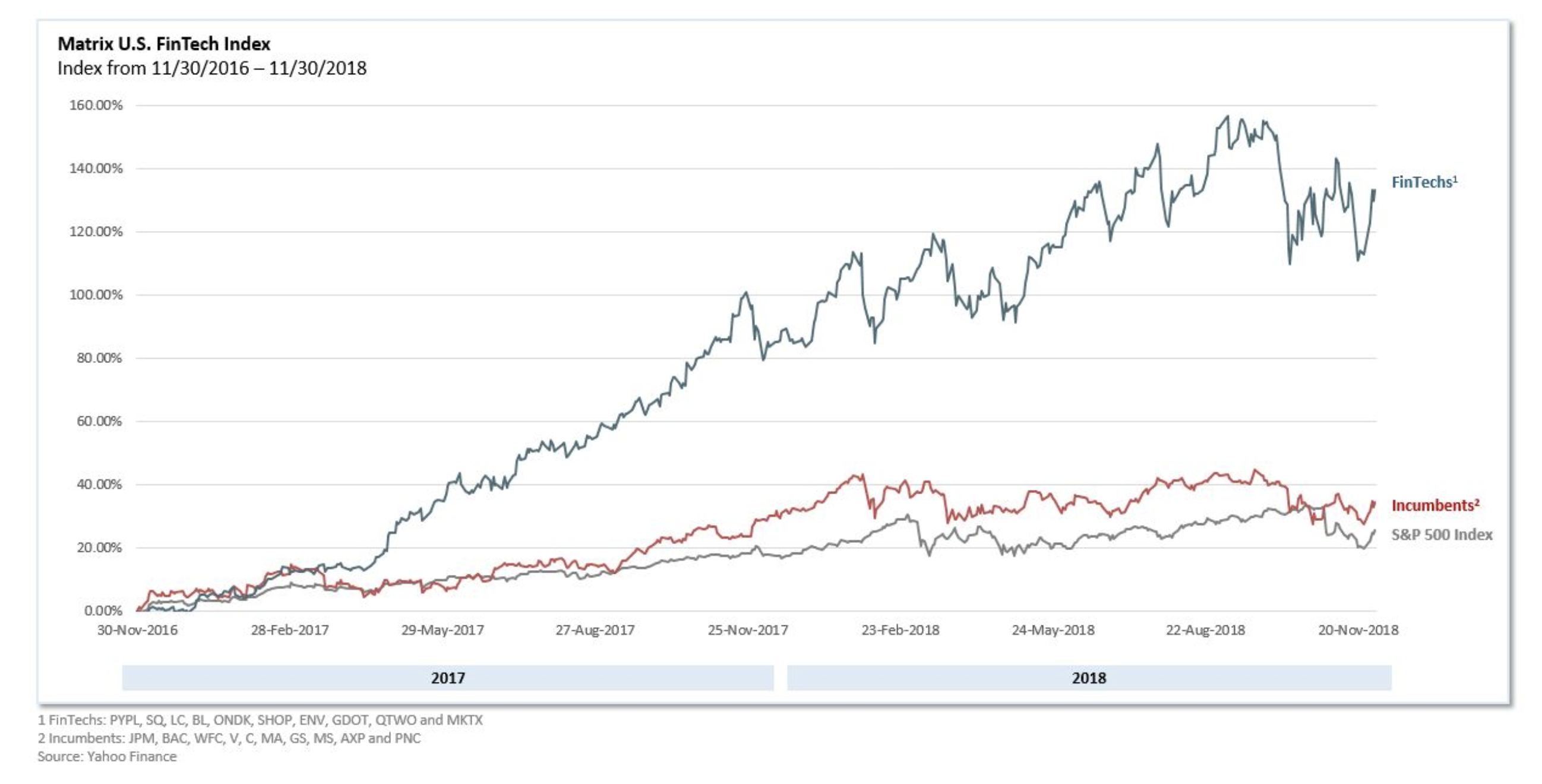
As we look back, this prediction proved to be true. The market cap of the Matrix FinTech Index grew 50 percentage points in 2018, far outpacing the incumbent financial service giants and the S&P 500. Looking ahead to 2019, we predict that the fintechs will continue to steal the show—creating innovative tech-enabled products, providing access to underserved demographics, and putting consumers first.

The FinTech Index continues to outperform in 2018, though volatility has increased

In this 2018 year-end edition of the Matrix FinTech Index[1] , we are excited to provide a refreshed view of last year’s index. As a quick reminder, the index is a market-cap weighted index that tracks the progress of a portfolio of 10 leading public fintech companies. For comparison, we also included another portfolio of 10 large financial services incumbents (companies like JP Morgan and Visa), as well as the S&P 500. In 2018, the total market cap of the top 10 publicly traded U.S. fintechs grew to nearly $170B and the 2-year returns of the fintechs are now at 133%–100 percentage points higher than the 2-year returns for the incumbents.

Definition: Matrix Partners considers “fintechs” to be venture-backed organizations that are (a) technology-first companies that leverage software to compete with traditional financial services institutions (e.g. banks, credit card networks, insurers, etc.) in the delivery of traditional financial services (e.g. lending, payments, investing, etc.) or (b) software tools that better enable traditional finance functions (e.g. accounting, point-of-sales systems, etc.)

Compared to 2017, volatility increased in 2018. While part of this is the broader state of the equity markets in 2018, it’s worth noting a few specific headwinds (e.g. the TIO security breach that impacted PayPal, Amazon launching Amazon Pay) as well as a few general macro concerns like rising interest rates. But looking ahead to 2019, all 10 of the publicly traded fintechs are expected to continue to have double-digit growth. The only incumbents expected to squeak into double-digit territory in 2019 are card issuers like Visa (11%) and Mastercard (13%) –enabled, in part, by the growth of fintech payment companies like Square and PayPal.

2019 Prediction: The Matrix FinTech Index will deliver 200% returns over the three years ending in December of 2019, outperforming the incumbents and S&P 500 by at least 150 percentage points.

Liquidity is starting to trickle in for private fintech companies

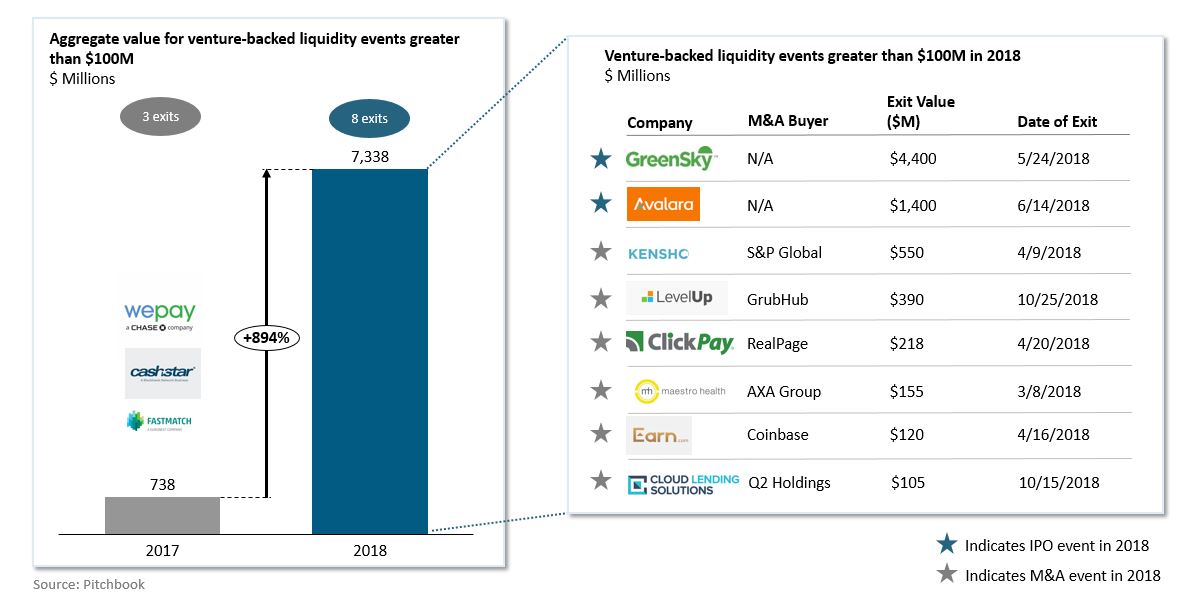
While the FinTech Index performed well on the public markets in 2018, we also saw some very promising liquidity events for privately held companies. In 2017, there were only 3 fintech exits in the U.S. over $100M, totaling just over $700M in value. In 2018 that number grew by a factor of 10 to over $7B in value. More than half of that value came from the GreenSky IPO, but there were also a number of significant M&A events. We expect M&A activity to increase as financial services incumbents acquire fintech companies in an effort to stay competitive. And we continue to believe that the fintech sector will prove to be one of the most fruitful sectors for venture returns in the 15 years following the 2008 financial crisis.

2019 Prediction: Total aggregate value for fintech liquidity events will exceed $10B in one year for the first time ever.

The fintech unicorn pipeline is primed for some big outcomes

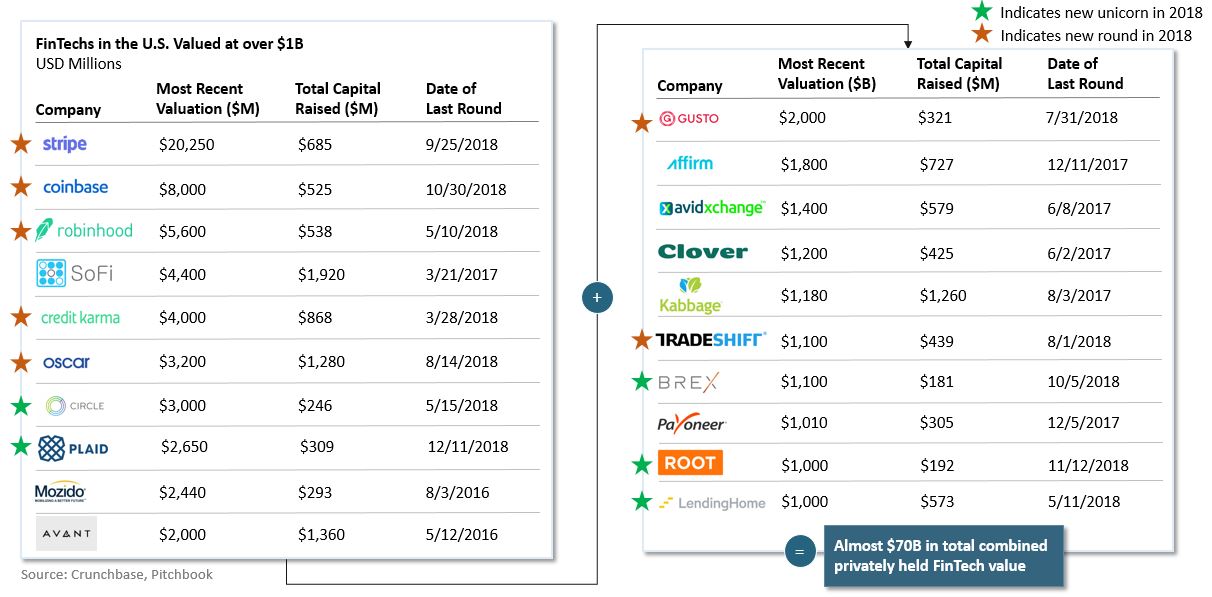
What’s even more exciting than 2018’s liquidity is the backlog of privately held fintechs, led by Stripe, that are valued at over $1B. There are now 20 fintech unicorns. In fact, there are more fintech unicorns than any other industry vertical in the Unicorn Club. More than 50% of these raised big growth rounds in 2018 and five of them (Circle, Plaid, Brex, Root and LendingHome) made their debut on the U.S. fintech unicorn list for the first time. The expansion of this list shows that there is no shortage of high-potential areas to disrupt in financial services.

2019 Prediction: Total aggregate value for fintech unicorns will cross $90B and the total number of fintech unicorns will begin to close in on 30.

The next wave of value creation from younger fintechs will be even bigger than the first

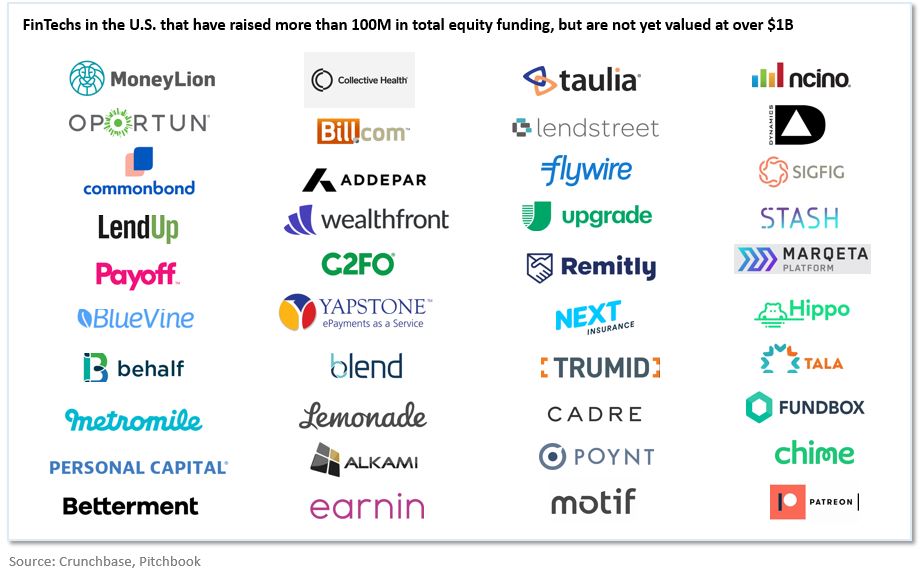
Despite these successes on the public markets, in liquidity events and among the unicorn ranks, we are still in the very early innings of the fintech revolution. 2019 will be even more impressive than 2018 as there are an additional 40 U.S. fintechs that have raised more than $100M in equity funding and are on the brink of entering the unicorn club. As many of these companies make that transition, they will sprout another wave of more interesting fintech companies as early employees go on to start their own companies in a virtuous wave of value creation.

We expect these newcomers, and others aspiring to follow in their footsteps, will threaten to end the rule of the financial establishment. They will continue to offer better financial products to consumers, empower more efficient payment channels, and create a more open financial system. At the same time, the incumbents will continue to struggle with innovation, hamstrung by their scale, regulatory burdens, and decades of accumulated technical debt.

Make no mistake. What new fintech companies are attempting is very ambitious and incredibly difficult to achieve. The existing ecosystem of incumbent providers dates back 150 years and represents some of the largest global financial institutions. That said, digital transformation is afoot and the financial service industry will not be spared.


from TechCrunch https://tcrn.ch/2GMEgpT