Tuesday, July 30, 2019

Real estate platform Compass raises another $370M on a $6.4B valuation en route to an IPO

The real estate market will forever go through ups and downs, but today comes big news for a startup in the space that has built a platform that it believes can help all players in it — buyers, sellers, and those who help with the buying and selling — no matter what stage of the cycle we happen to be in with a mixture of technology, data and transparency.

Compass — a startup that has built a three-sided marketplace for the industry, along with a wide set of algorithms to help make it work — has raised a $370 million round of funding, money that it plans to use to continue expanding to more geographies and expanding its R&D and product development. Sources tell me that it’s also now eyeing up an IPO, likely sometime in the next 24 months.

Based out of New York, Compass earlier this year established an engineering hub in Seattle run by the former CTO of AI for Microsoft, Joseph Sirosh. It’s continuing to hire there and elsewhere (alongside also making acqui-hires for talent).

The Series G funding — which brings the total raised by Compass to $1.5 billion — is coming in at a $6.4 billion valuation, a huge uptick for the company compared to its $4.4 billion valuation less than a year ago. Part of the reason for that has been the company’s massive growth: in the last quarter, its revenues were up 250% compared to Q2 2018.

The investor list for this latest round includes previous investors Canada Pension Plan Investment Board (CPPIB), Dragoneer Investment Group, and SoftBank Vision Fund. Other investors since it was first founded in 2012 have included Founders Fund, the Qatar Investment Authority (a construction and real estate giant), Fidelity and others.

The company was co-founded by Ori Allon and Robert Reffkin — respectively the chairman and CEO — with Allon holding a string of notable successes in the field of search to his name (his two prior startups were sold to Google and Twitter, which used them as the basis of large areas of their search and discovery algorithms).

In this latest entrepreneurial foray, Allon’s vision of using machine learning algorithms to improve decisions that humans make has been tailored to the specific vertical of real estate.

The platform is not a mere marketplace to connect buyers to real estate agents to sellers, but an engine that helps figure out pricing, timing for sales, how to stage homes (and more recently how to improve them with actual building work by way of Compass Concierge) to get the best prices and best sales. It also helps real estate agents manage their time and their customers (by way of an acquisition it made of CRM platform Contactually earlier this year). Starting with high-end homes for private individuals, Compass has expanded to commercial real estate and a much wider set of price brackets.

There is a wide opportunity for vertical search businesses at the moment. People want more accurate and targeted information to make purchasing decisions; and companies that are in the business of providing information (and selling things) are keen for better platforms to bring in online visitors and increase their conversions.

I understand that this has led to Compass getting approached for acquisitions, but that is not in the blueprint for this real estate startup: the longer term plan will be to take the company public, likely in the next 24 months.

“It has been incredible to see the growth of our Product & Engineering team, including the addition of Joseph Sirosh as CTO,” said Compass Founder & Executive Chairman Ori Allon, in a statement. “We are excited to partner with new investors, and deepen our relationship with our existing partners to accelerate our growth and further our technology advancements.”


from TechCrunch https://ift.tt/331E9xI

Honor 9X first flash sale pushes 100,000 units in 2 minutes

Honor 9X arrived with an elevating selfie camera and Kirin 810 chipset and today the first flash sale of the phone wrapped up. All 100,000 units of the phone and its Pro sibling were sold in 2 minutes and Honor reported it was twice as fast as the Honor 8X initial market launch back in September 2018. The Honor 9X and Honor 9X Pro share a footprint and a chipset, but they have different memory and number of cameras. While the regular one comes with 4/6 GB RAM and 64/128 gigs of storage, the Pro variant can be purchased with 8/256 GB memory. It also has one extra camera - an 8 MP...


from GSMArena.com - Latest articles https://ift.tt/2ypqPoR

Monday.com raises $150M more, now at $1.9B valuation, for workplace collaboration tools

Workplace collaboration platforms have become a crucial cornerstone of the modern office: workers’ lives are guided by software and what we do on our computers, and collaboration tools provide a way for us to let each other know what we’re working on, and how we’re doing it, in a format that’s (at best) easy to use without too much distraction from the work itself.

Now, Monday.com, one of the faster growing of these platforms, is announcing a $150 million round of equity funding — a whopping raise that points both to its success so far, and the opportunity ahead for the wider collaboration space, specifically around better team communication and team management.

The Series D funding — led by Sapphire Ventures, with Hamilton Lane, HarbourVest Partners, ION Crossover Partners and Vintage Investment Partners also participating — is coming in at what reliable sources tell me is a valuation of $1.9 billion, or nearly four times Monday.com’s valuation when it last raised money a year ago.

The big bump is in part to the company’s rapid expansion: it now has 80,000 organizations as customers, up from a mere 35,000 a year ago, with the number of actual employees within those organizations numbering as high as 4,000 employees, or as little as two, spanning some 200 industry verticals, including a fair number of companies that are non-technical in their nature (but still rely on using software and computers to get their work done). The client list includes Carlsberg, Discovery Channel, Phillips, Hulu and WeWork and a number of Fortune 500 companies.

“We have built flexibility into the platform,” Roy Mann, the CEO who co-founded the company with Eran Zinman, which is one reason he believes why it’s found a lot of stickiness among the wider field of knowledge workers looking for products that work not unlike the apps that they use as average consumers.

All those figures are also helping to put Monday.com on track for an IPO in the near future, said Roy Mann, the CEO who co-founded the company with Eran Zinman.

“An IPO is something that we are considering for the future, he said in an interview. “We are just at 1% of our potential, and we’re in a position for huge growth.” In terms of when that might happen, he and Zinman would not specify a timeline, but Mann added that this potentially could be the last round before a public listing.

On the other hand, there are some big plans up ahead for the startup, including adding in a free usage tier (to date, the only free on Monday.com is a free trial, all usage tiers have been otherwise paid), expanding geographically and into more languages, and continuing to develop the integration and automation technology that underpins the product. The aim is to have 200 applications working with Monday.com by the end of this year.

While the company is already generating cash and it has just raised a significant round, in the current market, that has definitely not kept venture-backed startups from raising more. (Monday.com, which first started life as Dapulse in 2014, has raised $234.1 million to date.)

Monday.com’s rise and growth are coming at an interesting moment for productivity software. There have been software platforms on the market for years aimed at helping workers communicate with each other, as well as to better track how projects and other activity are progressing. Despite being a relatively late entrant, Slack, the now-public workplace chat platform, has arguably defined the space. (It has even entered the modern work lexicon, where people now Slack each other, as a verb.)

That speaks to the opportunity to build products even when it looks like the market is established, but also — potentially — competition. Mann and Zinman are clear to point out that they definitely do not see Slack as a rival, though. “We even use Slack ourselves in the office,” Zinman noted.

The closer rivals, they note, are the likes of Airtable (now valued at $1.1 billion) and Notion (which we’ve confirmed with the company was raising and has now officially closed a round of $10 million on an equally outsized valuation of $800 million), as well as the wider field of project management tools like Jira, Wrike and Asana — although as Mann playfully pointed out, all of those could also feasibly be integrated into Monday.com and they would work better…

The market is still so nascent for collaboration tools that even with this crowded field, Mann said he believes that there is room for everyone and the differentiations that each platform currently offers: Notion, he noted as an example, feels geared towards more personal workspace management, while Airtable is more about taking on spreadsheets.

Within that, Monday.com hopes to position itself as the ever-powerful and smart go-to place to get an overview of everything that’s happening, with low-chat noise and no need for technical knowledge to gain understanding.

“Monday.com is revolutionizing the workplace software market and we’re delighted to be partnering with Roy, Eran, and the rest of the team in their mission to transform the way people work,” said Rajeev Dham, managing partner at Sapphire Ventures, in a statement. “Monday.com delivers the quality and ease of use typically reserved for consumer products to the enterprise, which we think unlocks significant value for workers and organizations alike.”


from TechCrunch https://ift.tt/2Op7peL

Truecaller pushes software fix after covertly signing up Indians to its payments service

Truecaller, a service that helps users screen robocalls, has rolled out an update to its app in India, its largest market, after a previous software release covertly signed up an unspecified number of users to its payments service.

A number of users in India began to complain late Monday that Truecaller, which has amassed over 100 million daily users in the country, had registered them to its payments service without their consent. In a statement to TechCrunch, Truecaller acknowledged the error and said a bug in the previous software update caused the issue.

“We have discovered a bug in the latest update of Truecaller that affected the payments feature, which automatically triggered a registration post updating to the version. This was a bug and we have discontinued this version of the app so no other users will be affected,” a Truecaller spokesperson said in a statement.

“We’re sorry about this version not passing our quality standards. We’ve taken quick steps to fix the issue, and already rolled out a fix in a new version. For the users already affected, the new version with the fix will be available shortly, however, in the meanwhile they can choose to manually deregister through the overflow menu in the app.”

Truecaller added payments service to its app in India two years ago. The company, like several others such as Google and Samsung, relies on Indian government-backed UPI payments infrastructure for this feature. Under the current law, signing up a user to a payments service without their consent is frowned upon.

As of February this year, every tenth Truecaller user in India had signed up to Truecaller Pay.


from TechCrunch https://ift.tt/2YAGBfi

Honor 20 Pro Icelandic Illusion color goes on sale in China

Honor's 20 series was announced back in May and seems to be well received by the Chinese public as it managed to surpass 1 million sales just 2 weeks after its launch. Now the phone is getting a new paint job dubbed Icelandic Illusion which is essentially a white back with pink and blue hues. The Icelandic Illusion Honor 20 Pro is listed on Huawei mall for CNY 3,199 ($464) in its 8GB RAM and 128GB storage version while the 8/256GB variant will set buyers back CNY 3,499 ($508). We recently got the chance to review the Honor 20 Pro and its Honor 20 sibling. Both devices come with...


from GSMArena.com - Latest articles https://ift.tt/2GzvDMQ

China’s Vivo is eyeing smartphone users in Africa and Middle East

Why this Nigerian fintech startup is volunteering audited financials

Nigerian fintech firm Carbon — an early stage financial services startup based in Lagos — has posted financials audited by KPMG on its website.

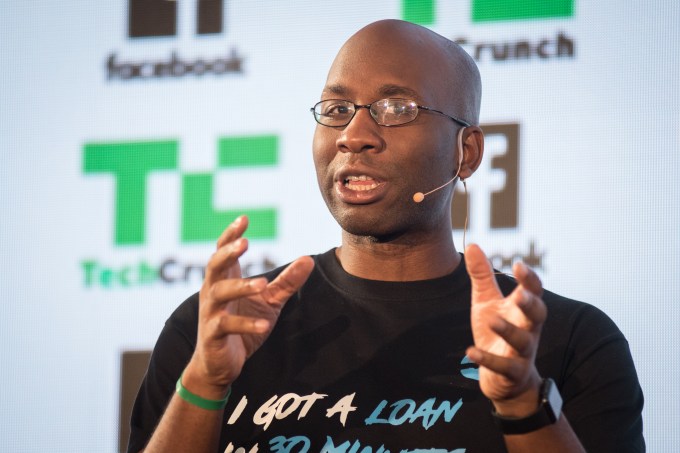
This comes four months after the company obtained a credit rating as a pre-IPO venture. Carbon — which recently rebranded its OneFi holding company and PayLater product titles into one name  — plans to continue releasing its financial results on an annual basis, co-Founder and CEO Chijioke Dozie told TechCrunch.

This may not be totally unheard of in other global tech markets, but for startups in Africa’s big tech hubs — such as Nigeria — it’s a rarity.

One of the first glimpses into startup financials in Nigeria came when Jumia shareholder, Rocket Internet, went public in 2014, which required it to include limited Jumia data in its annual report. The accompanying prospectus to Jumia’s listing this year on the New York Stock Exchange offered the most expansive financial data to date on a tech venture operating in Africa.

Prior to this — and still for the most part — companies in the continent’s (mostly) pre-public  (earlier stage) startup hubs — such as Nigeria — provide little to no financial performance info.

“Typically, in the local market, we have not seen a lot of voluntary transparency or the availability of data,” said Lexi Novitske — a Lagos based VC investor at Acuity Venture Partners.

“Most startups are concerned such disclosure could expose losses, give market intel to competitors, or attract unwanted attention from regulators. It could also lead to negative negotiation leverage if partners saw that they were making good returns.”

So why’d Carbon go to the trouble of putting its pre-public accounting out in the open for anyone to see?

Clients and recruiting were two reasons. “From a customer perspective, we are trying to get people to trust us with their financial services…so they can see this is the institution I’m dealing with and this is their financial position,” explained Carbon’s Dozie.

Carbon has evolved from its original focus as an online lender, to offer a broader array of mobile-based financial services — including payments, investment products, credit reports, and business banking services. In March, the company acquired Nigerian payment solutions company Amplify for an undisclosed amount.

By stats offered by Briter Bridges and a 2018 WeeTracker survey, fintech now receives the bulk of VC capital and deal-flow to African startups, many of which are attempting to reach the continent’s large unbanked and underbanked populations.

Carbon fits into that category and its CEO believes being up front about the startup’s financial position will attract top talent. “From a recruitment perspective, we want recruits to know we have good prospects — that this is a company that’s doing well and wants to keep doing well,” said Dozie.

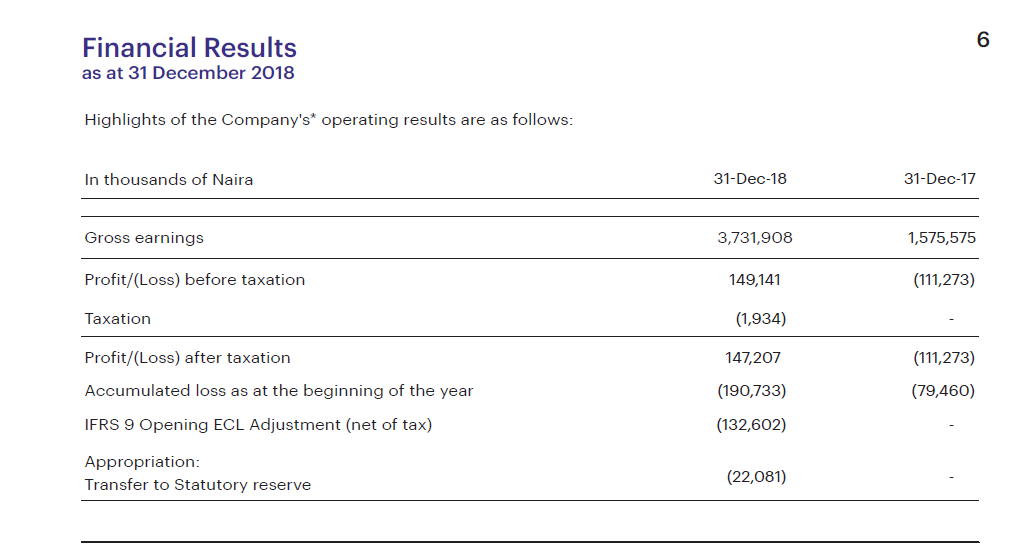
That impression is buoyed by Carbon’s initial results, which were fairly positive for a Series A stage startup. The company had revenues in 2018 of $10 million, according to its online annual report, and turned a profit of around $500,000.

It’s helped with recruiting interest, according to Dozie, who said he’d marked an increase in candidates inquiring about open positions since the results were posted.

Carbon Financial Results 2018 Nigeria Fintech II

The other reasons to volunteer financial data is to reassure investors (current and potential), shake off stereotypes for Nigeria, and better position Carbon globally.

“When you look at some of these challenger banks in the West, and you look at their numbers and our numbers, we could easily fit in with Monzo, N26, or Atom,” said Dozie.

“But we don’t get considered because investors don’t really think that you can get the results or this performance in the markets that we’re in,” he added —  noting that Carbon has operations in Nigeria, Ghana and South Africa and is considering expansion in Senegal, Côte d’Ivoire, DRC, and Egypt.

Investor Lexi Novitske thinks Carbon offering financial performance data is a good thing for Africa’s tech ecosystem. “The move builds trust from clients, partners, or investors in a market where there is not a lot of openness,” she said. “I am encouraged to see how other companies will react. My hope is that more will openly report their own metrics…”

Carbon CEO Chijioke Dozie says the company will continue to post audited financials on an annual basis, even if they show losses. If the startup continues to expand, attract capital, talent, and grow revenues, other Nigerian fintech firms may follow suit.


from TechCrunch https://ift.tt/2OsD676