The Station is a weekly newsletter dedicated to all things transportation. Sign up here — just click The Station — to receive it every weekend in your inbox.
Hello readers: Welcome to The Station, your central hub for all past, present and future means of moving people and packages from Point A to Point B. I’m back after a one-week hiatus. Did ya miss me? Yes, of course you did.
A lot happened while I was away and I’ll try my best to highlight the important stuff. Before I get to the hard news, I want to direct your attention to the latest founders Q&A — an ongoing series to highlight people who have started and are running transportation companies. Our twist? We will check on these founders a year from when their interview has been published.
This week, Zūm co-founder and CEO Ritu Narayan was in the hot seat. Check it out.
Also, it’s been awhile since I have directed y’all to The Autonocast, the podcast I co-host with Alex Roy and Ed Niedermeyer. We’ve had some great episodes in recent weeks, notably our interview with mobility-focused venture capitalist Olaf Sakkers. He joined the show to discuss “The Mobility Disruption Framework,” a funny, insightful book about the trends and technologies transforming the ways we get around. You can read the book here.
As always, you can email me at kirsten.korosec@techcrunch.com to share thoughts, criticisms, opinions or tips. You also can send a direct message to me at Twitter — @kirstenkorosec.
Nuro’s Nevada play
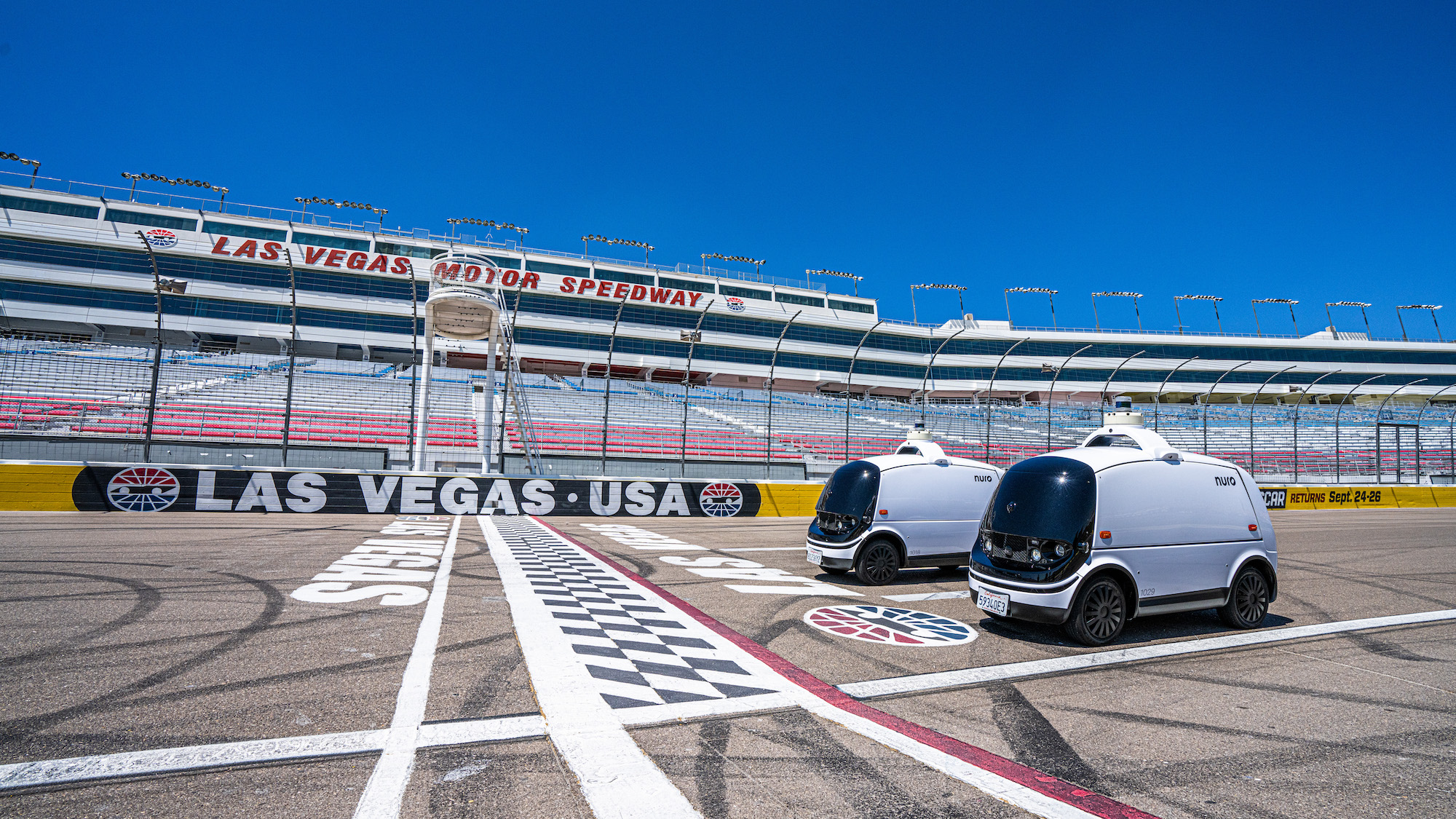
Image Credits: Nuro
Earlier this month, we published a series of articles that took a deep dive into autonomous vehicle technology company Nuro. We mentioned that the company was aiming to move into Nevada. Now, there are more details.
Nuro, which is applying its AV tech to delivery, is investing $40 million to develop a factory and closed course test track in southern Nevada. Nuro co-founder and CEO Jiajun Zhu said this will allow Nuro to “build tens of thousands of robots.”
And Nuro isn’t wasting any time getting started. Construction on the factory will begin in fall 2021 and is expected to be completed in 2022. Both the factory and closed-course testing facility are expected to be fully operational in 2022, the company said.
The factory, which will be more than 125,000 square feet, will be used to build Nuro’s third-generation autonomous vehicles with current and future partners. BYD North America will be Nuro’s manufacturing partner.
Nuro is also taking over 74 acres of the Las Vegas Motor Speedway to build a closed-course testing facility that will allow the development and validation of its autonomous on-road vehicles. The testing track will measure bot performance in a broad range of scenarios, from avoiding pedestrians and pets to giving bicycles space on shared roadways, as well as environmental tests and vehicle systems validation. the company said.
Deal of the week

Rivian has raised more than $10.5 billion in its lifetime, funds that have been directed towards the design, development and production of its first two electric vehicles as well as commercial vans for Amazon.
It’s a hefty sum that should be enough to fulfill that mission — and more. And yet, even Rivian is no match for the public market’s siren song.
The company, just weeks before its first electric pickup trucks are expected to be delivered to customers, confidentially filed paperwork with the U.S. Securities and Exchange Commission to go public. A Rivian IPO announcement has been expected for months now. The valuation the company is shooting for is the big surprise. If Bloomberg’s sources are right, Rivian is shooting for a valuation roughly around $80 billion.
That’s nearly three times larger than the last valuation I was able to nail down in January. At that time, the company had just raised another $2.65 billion from existing investors T. Rowe Price Associates Inc., Fidelity Management and Research Company, Amazon’s Climate Pledge Fund, Coatue and D1 Capital Partners. New investors also participated in that round, which pushed Rivian’s valuation to $27.6 billion, a source familiar with the investment round told TechCrunch at the time.
Rivian has raised more money since then. In July, the company announced it had closed a $2.5 billion private funding round led by Amazon’s Climate Pledge Fund, D1 Capital Partners, Ford Motor and funds and accounts advised by T. Rowe Price Associates Inc. Third Point, Fidelity Management and Research Company, Dragoneer Investment Group and Coatue also participated in that round. The company did not share a post-money valuation at the time of the July 2021 announcement.
Officially, Rivian says the size and price range for the proposed offering have yet to be determined.
Other deals that got my attention this week …
Coco, the Los Angeles delivery robot startup, raised $36 million in a Series A round led by Sam Altman, Silicon Valley Bank and Founders Fund, with participation from Sam Nazarian, Ellen Chen and Mario Del Pero. It brings the company’s total funding up to around $43 million.
DealerPolicy, an insurance marketplace for automotive retail, raised $110 million in a Series C rouond led by the Growth Equity business within Goldman Sachs Asset Management. Additional investors include 3L Capital and Hudson Structured Capital Management Ltd. Goldman Sachs’ Paul Pate will also join the company’s board of directors.
Getaround, the peer-to-peer car-sharing startup, is in talks to go public through a merger with special purpose acquisition company Altitude Acquisition Corp , Reuters reported. The company has confidentially sought investors to participate in the deal through a private placement in public equity, or PIPE, at a valuation of around $1.7 billion.
HyPoint, the two-year-old fuel cell developer, has secured a $6.5 million development agreement with Piasecki Aircraft Corporation for the design and certification of hydrogen fuel cell systems. Through the partnership, HyPoint aims to deliver five full-scale, 650 kilowatt hydrogen fuel cell systems for ground testing, demo flights and the certification process.
KKR, the global investment firm, has plans to acquire New Zealand bus and coach company Ritchies Transport, which currently has a fleet of more than 1,600 vehicles and 42 depots that operate across the country. The terms of the deal were not disclosed, but sources familiar with the circumstances say the deal values Ritchies at over $347 million ($500 million NZD). This is KKR’s first infrastructure investment in New Zealand.
Malta Inc., an energy storage company, said that Chevron Technology Ventures and Piva Capital have joined a group of investors including Proman, Alfa Laval, Breakthrough Energy Ventures and Dustin Moskovitz in its oversubscribed Series B financing, increasing the round to more than $60 million.
MaxAB, the Egyptian B2B e-commerce platform that serves food and grocery retailers, raised a $15 million extension from existing investors RMBV, IFC, Flourish Ventures, Crystal Stream Capital, Rise Capital, Endeavour Catalyst, Beco Capital and 4DX Ventures. The extension brings its total Series A fundraise to $55 million.
Point Pickup Technologies, a last-mile delivery service, acquired white-label e-commerce platform GrocerKey for $42 million. The acquisition means Point Pickup will be able to offer retailers services such as same-day delivery under their own brand name, rather than under third parties like Instacart.
Upstream, the Israeli automotive security firm, raised $62 million in a Series C funding round led by Mitsui Sumitomo Insurance and was joined by new investors I.D.I. Insurance, 57 Stars’ NextGen Mobility Fund and La Maison Partners. Existing investors Glilot Capital, Salesforce venture, Volvo Group Venture Capital, Nationwide, Delek US and others also participated in the round. With this latest round, the company has raised a total of $105 million since its founding in 2017.
Volvo Group has agreed to buy heavy duty truck subsidiary of Jiangling Motors Corp for about 1.1 billion Swedish crowns ($125.7 million) to make trucks in China, Reuters reported.
Policy corner

Welcome back to policy corner! The stalemate over the budget reconciliation that I warned might take months to break — just kidding! The House managed to pass the $3.5 trillion budget resolution and made progress on the $1 trillion bipartisan infrastructure bill on Tuesday, in a 220-212 bipartisan vote. The vote includes a non-binding agreement to vote on the infrastructure bill by Sept. 27.
The path is now clear for Democrats to pass one of the most socially progressive budgets in decades, with a slew of social safety net provisions for childcare, healthcare, climate and education. House Speaker Nancy Pelosi had previously sworn she would stall the infrastructure bill until the budget passed, so the infrastructure bill passing sometime in our lifetime is suddenly looking like a much more realistic proposal!
Progressive Democrats in particular are committed to keeping the fate of the two bills intertwined. “We will only vote for the infrastructure bill after passing the reconciliation bill,” Progressive Caucus chairwoman, Rep. Pramila Jayapal (D., Wash.), said in a statement.
Speaking of the two bills… while consumer incentives for electric vehicles were slashed from the infrastructure bill, they did survive the budget reconciliation. Right now, there currently exists a 30D tax credit, but the $7,500 incentive doesn’t include automakers that have sold more than 200,000 EVs (so General Motors and Tesla don’t qualify).
Leilani Gonzalez with the Zero Emission Transportation Association urged reform to the EV tax credit. She suggested that Congress slash means-testing for the credit, like one that only allows people under a certain annual income to access it.
“Congress should ensure that this tax credit is not impeded by restrictive means-tested requirements, like low manufacturer’s suggested retail price (MSRP) or adjusted gross income (AGI) caps,” she wrote. “These limitations ignore the public benefits of EVs that leave everyone better off, and they would only serve to hinder EV adoption.”
Even beyond reform, some Democrats are pushing for a direct cash rebate — meaning that the dollar amount would just be taken off the cost of the car at the point of sale, rather than the consumer having to wait to get that money back at tax time. But we’re still a long way from seeing a new kind of consumer incentive put into law, with some Democrats urging a $12,500 tax credit, and others arguing for a rebate, with still others arguing for either but with means-testing like what Gonzalez writes about.
In any case, we’ll be keeping an eye on it. It’s very hard to imagine how the country will achieve any kind of meaningful transition to electric vehicles by 2030 without some mechanism to make them easier (and cheaper) to buy.
In other news, the Federal Aviation Administration is spending $20.4 million in grants to airports who want to electrify equipment and transition to ZEVs. This isn’t about the planes themselves, though they tend to get the most media attention. These grants would be for less sexy things like airport shuttle buses and mobile ground power units, but which collectively still generate a lot of greenhouse gas emissions. The FAA has earmarked $300 million out of its $3.5 billion budget for electrification initiatives.
— Aria Alamalhodaei
Notable news and other tidbits

It’s one of those weeks folks. Lotta news so let’s get down to it.
ADAS
Tesla CEO Elon Musk admitted that the latest version of its so-called FSD tech — which is an upgraded version of its Autopilot advanced driver assistance system — is “not great.” He went on to write that the “Autopilot/AI team is rallying to improve as fast as possible. We’re trying to have a single tech stack for both highway & city streets, but it requires massive [neural network] retraining.”
Autonomous vehicles
Cruise, GM’s self-driving car subsidiary, launched a new initiative called Farm to Fleet that will allow the company to source solar power from farms in California’s Central Valley. Cruise is directly purchasing renewable energy credits from Sundale Vineyards and Moonlight Companies to help power its fleet of all-electric autonomous vehicles in San Francisco.
Jalopnik’s Jason Torchinsky has a great explainer on the various levels of SAE autonomy.
Toyota suspended the operation of its e-Palette autonomous shuttles — which do have two human safety operators on board — at the Paralympic Games Athletes’ Village after one of the shuttles struck an athlete. The schedule for resuming operations at the Paralympic Games has not yet been determined, the company said. A spokesperson also noted to me that only the shuttles at the Olympics were halted. The e-Palette program is still operational.
Update: Since the newsletter went out to subscribers over the weekend, Toyota has restarted the e-Palette shuttles in the Olympic village. It’s important to note that these shuttles use a combination of manual and autonomous driving modes while underway. Toyota President Akio Toyoda apologized for the incident during a recent interview. The translation provided in closed captioning isn’t great, but he does make some interesting comments about the readiness of autonomous vehicle technology. In short: it’s not ready and humans are still better drivers.
Waymo has launched a robotaxi service that will be open to certain vetted riders in San Francisco. The company officially kicked off its Waymo One Trusted Tester program in the city with a fleet of all-electric Jaguar I-PACEs equipped with the company’s fifth generation of its autonomous vehicle system. This is a big step for Waymo and we’ll be watching closely to see how the ramp mirrors, or differs, from its service in the Phoenix area.
Greg Bensinger took a look at the terms of service on the Waymo One ride-hailing app and in a tweet thread provides a breakdown of what riders are agreeing to, including that the company will record video of riders while being driven around San Francisco.
Waymo also has decided to get out of the lidar sales business as it shifts its focus to deploying its autonomous vehicle technology across its ride-hailing and trucking divisions. In 2019, Waymo announced it would sell its short-range lidar, called Laser Bear Honeycomb, to companies outside of self-driving cars. It initially targeted robotics, security and agricultural technology.
Electric vehicles
GM expanded (again) its recall of Chevrolet Bolt electric vehicles due to fire risks from battery manufacturing defects. The automaker said it would seek reimbursement from LG Chem, its battery cell manufacturing partner, for what it expects to be $1 billion worth of losses. this is the third recall GM has issued for this vehicle related to batteries.
Lordstown Motors hired Daniel A. Ninivaggi, a longtime automotive executive and former head of Carl C. Icahn’s holding company, as CEO and a board member. The appointment follows months of tumult at Lordstown, which became publicly traded via a merger with a special purpose acquisition company.
Other bits
Aria Alamalhodaei wrote up a feature on Buoyant, a recent Y Combinator grad and one of several airship startups that have popped up recently.
Mercedes-Benz’s chief technology officer Sajjad Khan is leaving the automaker to start a venture capital fund, the company said in a statement. Khan’s replacement, Magnus Östberg, will take over the CTO role effective Sept. 1.
Porsche Cars North America added its entire U.S. inventory of new cars to an online marketplace that it launched in May 2020. The platform called Porsche Finder is one of the ways the automaker is trying to keep up with customer demands and the industry’s shift to digital commerce. The product lets customers search by vehicle model and generation as well as price, equipment, packages and colors, on all new and used vehicle inventory from its 193 U.S. dealerships.
Tesla wants to supply electricity directly to customers, according to an application filed with Texas electricity regulators earlier this month. Energy Choice Matters first reported on the application.
The application, filed with the Public Utilities Commission of Texas on August 16, is a request to become what’s called a “retail electric provider” under its subsidiary Tesla Energy Ventures. On the deregulated, idiosyncratic Texas power market, REPs generally purchase wholesale electricity from power generators and sell it to customers. More than 100 REPs currently compete on the open market.
from TechCrunch https://ift.tt/3ytewVg