Sunday, March 26, 2023

Forget banks: Investors should be worrying about the climate

The reports issued by the U.N.’s Intergovernmental Panel on Climate Change are usually grim affairs. But even by that standard, last week’s seemed particularly bleak.

The upshot is that the world has already warmed by 1.1 degrees Celsius, and we’re on track to hit 1.5 degrees Celsius — the “safe” limit set by the Paris Agreement — in the early 2030s. So unless we make drastic changes, the world will blow past the amount of warming deemed safe, just 10 years from now.

There’s a good chance that by the time 30- and 40-year-olds hit retirement, the world will be shitting the bed. The hurricanes, heat waves, polar vortices, fires, floods, droughts — all the things that make us stock the pantry, invest in backup power, and beef up our insurance policies — we’ll be waxing nostalgic about those. Wasn’t it cute how bad we thought things were back then?

Where the fuck is the panic?

To be sure, plenty of people are worried. Problem is, most of them don’t have (or can’t marshal) the sorts of sums required to put a dent in the problem. Meanwhile, those who do are largely sitting out one of the biggest crises — and one of the biggest opportunities — of their lifetimes.

There are a handful of investors who “get it,” but most don’t. Rather than invest in fusion or batteries or carbon capture or grid management tools, they seem content plowing their money into ad optimization software, corporate spend cards, corporate SaaS platforms — CRM, marketing, or payments, take your pick! — or anything to do with the metaverse, really. One after another after another. (Soon, AI chatbots will join the list because, come on, have you seen what happens after the latest toy lands on “60 Minutes”? It’s like a bunch of high schoolers rushing to ape the latest TikTok trend.)

And when they’re not busy financing incrementalism, they’re giving failed wunderkinds hundreds of millions of dollars or fanning the flames of runs on regional banks. Is that what they aspire to?

It would be less frustrating if venture capitalism weren’t tailor-made to tackle a problem like this. Sizable but manageable risks? Check. Needle-moving technologies? Check. Enormous upsides and the potential to refashion trillion-dollar markets? Check and check.

Where is everybody?

Let’s compare two vastly different markets to illustrate the problem. Over here we have software as a service, which investors have lavished with money and attention because those companies produce recurring revenue, which is often steadier and more predictable. Altogether, SaaS companies worldwide raised $122 billion last year, according to PitchBook. In other words, to fund companies that lease software on a monthly basis rather than sell perpetual licenses, VCs invested more money than the entire GDP of Slovakia.

On the other side we have clean energy, which includes everything from batteries to renewable fuels, building electrification, solar, wind and more. Here, investors placed $40 billion worth of bets last year. In case you’re bad at math, investments that eliminate carbon pollution in myriad sectors of the economy were one-third those made just to sell software on a monthly basis.

Venture capitalists once backed companies that took big, consequential swings. In 1946, VC pioneer American Research and Development handed the founders of High Voltage Engineering a $200,000 check to develop a fledgling technology known as X-rays to treat cancer. At $2.8 million in today’s dollars, that may not seem like a lot of money. But remember, apart from ARD, venture capital didn’t exist back then.

Today, those big swings are similarly modest. Probably too modest. Investors should be collectively ramping up their ambitions, but the numbers don’t reflect that. Let’s look at two “big swing” techs: carbon capture and fusion energy. Last year, global VC firms invested just $4.25 billion in carbon capture and a mere $1.1 billion in fusion energy, per PitchBook. Together, they represent a “get out of jail free” card, allowing humanity to produce enough energy to drive the power-hungry process of reversing nearly 200 years of unchecked carbon pollution.

Fusion represents perhaps the riskiest bet of them all. The science has progressed rapidly in recent years, and many startups express growing confidence in their timelines, but there’s still plenty of risk involved. Yet the technology has such tremendous potential, both for the climate and for returns, that investors should be pouring enormous sums into the market.

In that way, fusion shows a way forward. Most fusion companies will need a lot of money, and most probably won’t pan out. But those that do will deliver significant returns. Today, the global energy market is worth $10 trillion. If one company could capture even a sliver of that, it would be rewarded with an absolutely stratospheric valuation.

Given the risky but promising nature of a fusion-heavy portfolio, let’s assume for the sake of argument that investors will need 1,000x return from a winner to cancel out losses from their failed bets. If today’s portfolios assume winners need to return 10x, that means venture capital will need to take 100x more shots. So either firms need to get way bigger or there need to be way more of them. The easiest solution, of course, would be for more firms to dive into fusion. But that would mean that many would fail, too.

Fortunately, fusion isn’t the only climate tech that’s in need of investment. Opportunities are multiplying by the day. Some are riskier than others, but all of them are bets on the future. And given that all of our futures are tied to the climate, if any of those bets pay off, the returns will accrue not just to investors, but to everyone. In climate tech, venture capital has a chance to get back to its roots — investing not just for money, but to change the world.

Forget banks: Investors should be worrying about the climate by Tim De Chant originally published on TechCrunch


from TechCrunch https://ift.tt/DtIG1Ju

The layoffs will continue until (investor) morale improves

Since the start of 2023, more than 150,000 people have been laid off at tech companies, large and small. That’s a staggering number of people who have been put out of work.

When you think about how Meta, Amazon and Salesforce have handled these layoffs, the situation becomes even more grim.

Salesforce announced in January that it was laying off 10% of its approximately 80,000 employee workforce. Since then, it has been letting people go in dribs and drabs. Amazon also announced in January that it was laying off 18,000 employees, then announced another 9,000 this week. Meta laid off 11,000 in November and let another 10,000 people go in a second round this week. In addition, the company shut down another 5,000 open recs.

This, some would say, cruel, rolling approach to layoffs leaves employees anxious and uncertain about their own positions, while grieving about the loss of valued colleagues who have been let go.

Investors, on the other hand, seem to like layoffs as a way to move companies toward greater operating efficiency. CEOs typically are less concerned about the well being of their employees as they are in keeping investors happy.

An argument could be made, of course, that these companies overhired during the recent tech boom, and now it’s time to right size to better fit a changing market. That argument would carry more weight if the companies in question weren’t profitable. However, large American tech companies are very often both profitable and incredibly wealthy, even if their market cap has fallen from record highs.

While there is some truth to the idea that companies grew too quickly in recent years and need to reset, layoffs feel like the worst kind of short-term thinking: sacrificing employees to please investors. Are companies at least getting what they want from investors out of this devil’s bargain?

Investor response

If companies are looking to impress investors with their cost-cutting measures, we can rate how effective their layoffs are by how investors have reacted to them.

The layoffs will continue until (investor) morale improves by Ron Miller originally published on TechCrunch


from TechCrunch https://ift.tt/9bGdOLr

Pinterest brings shopping capabilities to Shuffles, its collage-making app

Pinterest announced today that it’s testing ways to integrate Shuffles collage content into Pinterest, starting with shopping. Shuffles, which is Pinterest’s collage-making app, launched to general public last November. To use Shuffles, users build collages using Pinterest’s own photo library or by snapping photos of objects they want to include with their iPhone’s camera. The iOS-only app is available in the U.S., Canada, Great Britain, Ireland, Australia and New Zealand.

Shuffles will now have all of the shopping capabilities as regular pins. Users will be able to tap individual cutouts used in collages, see the brand, price, and other product metadata along with similar products to shop.

“Unlike typical product exploration, Shuffles bring an interactivity that makes the experience inspirational and fun,” the company said in a blog post. “Gen-Z is curating fresh, relevant content alongside their peers, which is quickly making for a marketplace of trendy, shoppable ideas. The high density nature of Shuffles, which can include layers of product cutouts from multiple Pins, allows consumers to dig deeper and also connect to other Shuffles that include the same Pins. As we look ahead to how consumer behavior is evolving, we’re testing ways of integrating Shuffles collage content into Pinterest, starting with shopping.”

Although Shuffles surged to become the No. 1 Lifestyle app on the U.S. App Store in August when it was invite-only, the app’s popularity has since declined. By bringing shopping capabilities to Shuffles, Pinterest is likely looking for ways to retain users on the standalone app.

Image Credits: Pinterest

Pinterest also announced that it’s exploring a new takeover feature for advertisers called “Pinterest Premiere Spotlight” that prominently showcases a brand on search. The company says the feature is designed give advertisers a new way to reach users on Pinterest.

The company says 97% of top searches on Pinterest are unbranded, which means users typically don’t type a brand name into their searches on the platform. This gives brands the opportunity to be discovered as they help consumers go from discovery to decision to purchase, Pinterest says. In the coming months, the company planes to offer additional ways to help brands connect with shoppers.

Pinterest also shared some new stats about its Catalogs offering, which lets brands upload their full catalog to the platform and turn their products into dynamic Product Pins. The company says it has seen a 66% increase in retailers setting up shop by uploading or integrating their digital catalogs on its platform, along with 70% growth in active shopping feeds year over year globally.

As part of its most recent earnings release, Pinterest revealed that its platform now has 450 million monthly active users globally, a 4% jump year-on-year. Pinterest has been focused on enhancing the shopping experience on its platform over the past few years, and said during its earnings call that it wants to make every pin shoppable, including videos.

Pinterest brings shopping capabilities to Shuffles, its collage-making app by Aisha Malik originally published on TechCrunch


from TechCrunch https://ift.tt/hpvWnVu

vivo V27 in for review

The vivo V27 is the latest device to came to our office this week so while it's paitiently waiting for its review to start, we'll do a quick unboxing. The V27 ships with a mighty 80W charger, a USB cable, and a case, making for a solid package. We have the Emerald Green vivo V27, which uses the Emerald Glass processing technique. Like vivo's Fluorite AG Glass designs, the Emerald Glass will also change its color when exposed to UV light. Before it's exposed to UV, the phone is a light green that gradients to a deeper hue at the bottom of its rear panel. After UV light exposure,...


from GSMArena.com - Latest articles https://ift.tt/FOB0ptS

Saturday, March 25, 2023

Apple to launch AirPods Pro 2's USB-C version later this year

Apple recently rolled out the iOS 16.4 release candidate for developers, which includes references to new AirPods with model code A3048 and a new AirPods case bearing model designation A2968. According to famous analyst Ming Chi-Kuo, these are likely the USB-C version of AirPods Pro 2 launched last year with a Lightning port, and their mass shipments are expected between 2Q23-3Q23. AirPods Pro 2 launched last year with Lightning port Kuo didn't divulge anything else about the AirPods Pro 2's USB-C version, and it's unclear if these will just be the AirPods Pro 2 coming in a charging...


from GSMArena.com - Latest articles https://ift.tt/Y9AXfPU

‘So infuriating’: TikTokers are fuming over potential ban

In the aftermath of TikTok CEO Shou Zi Chew’s brutal five hour Congressional hearing on Thursday, TikToker and disinformation researcher Abbie Richards summed up what so many creators were thinking: “It’s actually remarkable how much less Congress knows about social media than the average person,” Richards told TechCrunch.

Across TikTok, users mocked congresspeople for misunderstanding how technology works. In one instance, Representative Richard Hudson (R-NC) asked Chew if TikTok connects to a user’s home wi-fi network. Chew responded, bewildered, “Only if the user turns on the wi-fi.”

The ignorant questions weren’t unique to the government’s interrogation of Chew. At a high-profile hearing 2018, the late Senator Orrin Hatch (R-UT) infamously asked Meta CEO Mark Zuckerberg how Facebook makes money if the app is free. Zuckerberg responded, “Senator, we run ads,” failing to stifle a smirk. During a tech hearing two years ago, Senator Richard Blumenthal (D-CT) created another notorious viral moment by asking Facebook’s global head of safety if she would “commit to ending finsta.”

As entertaining as these lapses in basic knowledge are, TikTok creators have serious concerns about the future of an app that’s given them a community, and, in some cases, a career.

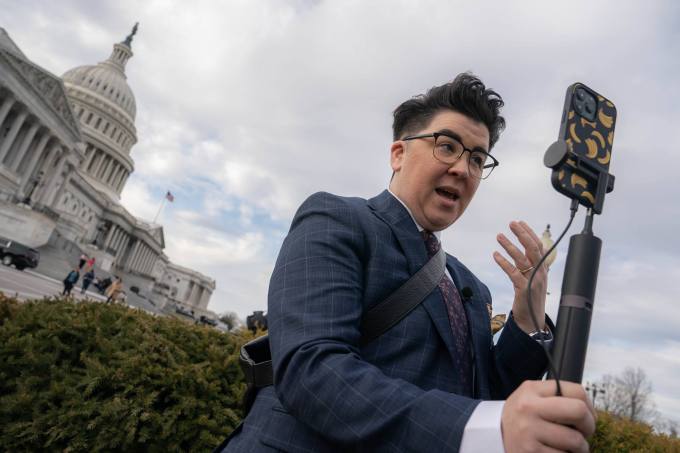
TikTok creator Vitus “V” Spehar, known as Under the Desk News, has amassed 2.9 million followers by sharing global news in an approachable way. But in this week’s news cycle, they’re front-and-center (literally — they sat right behind the TikTok CEO as he testified).

“I think it’s really concerning that a government is considering removing American citizens from the global conversation on an app as robust as TikTok,” Spehar told TechCrunch. “It’s not just banning the app in the United States, it means disconnecting American citizens from Canada, the UK, Mexico, Iran, Ukraine and all of the frontline reporting you see from those countries, it just shows up on our [For You Page].”

Spehar is part of a group of TikTok creators who travelled to Washington, D.C. this week to advocate on TikTok’s behalf — and against the looming threat of a national ban. They participated in a press conference on Wednesday afternoon hosted by Representative Jamaal Bowman (D-NY), a rare dissenting voice in Congress who raised questions about what he described as the “hysteria and panic” surrounding TikTok.

Vitus Spehar, host of the TikTok channel Under The News Desk, hosts a live stream during a news conference outside the US Capitol in Washington, DC, US, on Wednesday, March 22, 2023.

Vitus Spehar, host of the TikTok channel Under The News Desk, hosts a live stream during a news conference outside the US Capitol in Washington, DC, US, on Wednesday, March 22, 2023. (Nathan Howard/Bloomberg)

“Congress made clear that they don’t understand TikTok, they don’t listen to their constituents who are in the community of TikTokers — and are using this TikTok hysteria as a way to pass legislation that gives them superpowers to ban any app they deem ‘unsafe’ in the future,” Spehar said following the hearing.

Tech ethicists and creators alike share this frustration. Dr. Casey Fiesler, a University of Colorado Boulder professor of tech ethics and policy, believes that the national security concerns about the app are overstated.

“The risk seems to be entirely speculative right now and to me, I’m not sure how it is substantially worse than all of the things that are troubling about social media right now that the government has not been focusing on,” Fiesler said. She commands an audience of over 100,000 followers on TikTok, where she explores issues like the nuances of content moderation and other topics that might come up in her graduate courses.

“I don’t think there’s any way to frame this as a general data privacy issue without going after every other tech company,” Fiesler told TechCrunch. “The only thing that makes sense is that it’s literally only about the fact that the company is based in China.”

There is still no evidence that TikTok has shared data with the Chinese government. But reports have shown that employees at TikTok’s Beijing-based parent company ByteDance have viewed American user data. An investigation last year revealed that engineers in China had open access to TikTok data on U.S. users, undermining the company’s claims to the contrary. Another report, corroborated by ByteDance, found that a small group of engineers inappropriately accessed two U.S. journalists’ TikTok data. They planned to use the location information to determine if the reporters had crossed paths with any ByteDance employees who may have leaked information to the press.

Still, TikTokers point to the distinction between sharing data with a private Chinese company and the Chinese government. For its part, TikTok has tried to appease U.S. officials with a plan called Project Texas, a $1.5 billion undertaking that will move U.S. users’ data to Oracle servers. Project Texas would also create a subsidiary of the company called the TikTok U.S. Data Security Inc., which plans to oversee any aspect of TikTok involving national security.

Spehar said that they favor solutions like Project Texas over U.S. government proposals like the RESTRICT Act, which would give the U.S. new tools for restricting and potentially banning technology exports from foreign adversaries.

“I don’t think we should be looking at things like the RESTRICT Act, or any kind of broad legislation that gives the government the power to say, ‘We’ve decided something is unsafe,'” they told TechCrunch.

Multiple congresspeople asked Chew about how TikTok moderates dangerous trends like “the blackout challenge,” in which children tried to see how long they can hold their breath. Children died from this behavior after it circulated on TikTok, but the game didn’t originate on the platform: As early as 2008, the CDC warned parents that 82 children had died from a trend called “the choking game.” One congressman even referenced “NyQuil chicken” as a dangerous TikTok trend, despite the fact that there is little evidence anyone actually ate chicken soaked in cough medicine and the trend originated years ago on 4chan.

“The moral panic over TikTok challenges is something I’ve debunked extensively, and then they just get parroted by these politicians that don’t understand what a moral panic is,” Richards told TechCrunch. “To utilize misinformation that I’ve written about so much and tried to debunk, and to see it used against TikTok was just so infuriating.”

Richards does acknowledge that TikTok’s best feature is also its worst: Anything can go viral. She believes TikTok’s “bottom-up” information environment does lend itself to misinformation, but that same dynamic also surfaces good content that would never get exposure on a different social network.

Richards is also a vocal critic of TikTok’s content moderation policies, which — like every other social network — are not always applied evenly. During Thursday’s hearing, Rep. Kat Cammack (R-FL) dramatically screened a month-old TikTok video depicting a gun alongside text threatening the leader of the House Committee that orchestrated Chew’s testimony. It’s an obvious violation of TikTok’s content guidelines, but Richards points out that it had very little engagement.

“In the context of TikTok, something having 40 likes is effective moderation,” Richards said. “That means the video isn’t reaching very many people.” She believes that a video like the one the Florida lawmaker highlighted shouldn’t be on the platform at all, but ultimately if it doesn’t reach many users then the potential for harm is limited.

Other creators expressed frustration that congresspeople failed to consider how TikTok has helped Americans, like LGBTQ+ people who found community on the app or small business owners who were able to grow beyond their wildest dreams after going viral.

Trans Latina creator Naomi Hearts, who has 1 million TikTok followers, was invited by TikTok to support the app in D.C. (TikTok compensated this group of creators, which included Spehar, by covering lodging and travel costs). She said that she met other TikTokers on the trip who used the app to gain traction for their small businesses.

She too found an audience on TikTok that she wasn’t able to build elsewhere, after struggling to grow a following on Instagram. But on TikTok, even small accounts have the potential to go viral, a phenomenon that can jumpstart a career when things work out.

“The message of the normal person… for example, me, who was just a plus sized trans woman who grew up in South Central Los Angeles and had a dream — my message was not there,” Naomi Hearts said, referring to Instagram.

Spehar also emphasized the role that TikTok plays in helping people connect well outside the bounds of their everyday surroundings.

“You can find communities that you can’t where you live,” Spehar said. “I think about kids in Northwest Arkansas and in Tennessee — TikTok is literally one of the reasons they’re not taking their lives, because they know they’re not alone.”

Although Richards mostly writes about disinformation on TikTok, she laments the positive sides of the app that could be lost if it gets banned in the U.S.

“Banning TikTok would ultimately harm marginalized communities the most, who are least represented by institutional news and organizations,” Richards said. “And if all of a sudden, that entire infrastructure disappears, they will just suddenly in be the dark.”

‘So infuriating’: TikTokers are fuming over potential ban by Amanda Silberling originally published on TechCrunch


from TechCrunch https://ift.tt/RzaCHe7

Xiaomi TV Stick 4K review

The Xiaomi TV Stick 4K is the company's latest entry-level 4K media streaming device. It's the usual sort of compact, dongle-like design that has become very popular with consumers as media streaming usage skyrockets. This new model supports most of the popular new audio/video formats along with the new Google TV interface. Priced at INR 4,999, the Xiaomi TV Stick 4K goes head-to-head with the Amazon Fire TV Stick 4K, which retails for the same price. Design and remote The Xiaomi TV Stick 4K comes in simple paper packaging. Inside you'll find the streaming stick, a Bluetooth...


from GSMArena.com - Latest articles https://ift.tt/1MNxG3R